Let’s Be Honest About Something
Most business owners I’ve spoken with didn’t wake up one day and realize their management was broken.
It crept up on them.
A missed deadline here. A frustrated employee there. A customer complaint that somehow slipped through the cracks. Each thing felt minor on its own. Manageable. Something to deal with “when things slow down.”
But things never really slowed down. And what looked like small hiccups? They quietly became the ceiling on everything — growth, profitability, peace of mind.
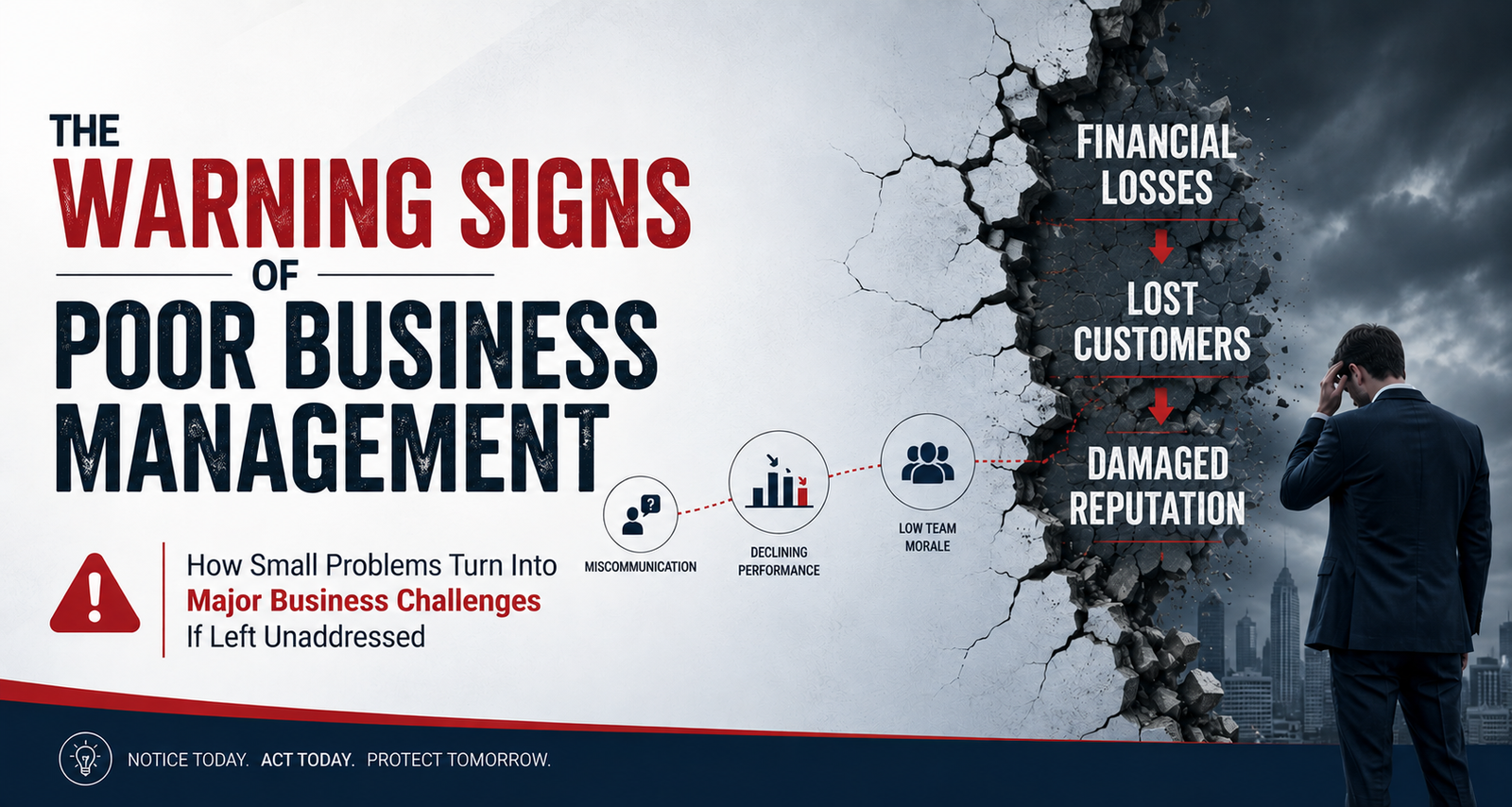
That’s the thing about poor business management. It rarely announces itself. It just keeps quietly costing you.
What Good Management Actually Does
Before we talk about warning signs, it’s worth being clear about what management is actually supposed to do.
It’s not about control or hierarchy. At its core, management is about making sure the right things happen reliably — that your team knows what to do, your resources go where they matter most, and your customers consistently walk away satisfied.
When that system works, everything flows. When it doesn’t, you feel it everywhere — in your numbers, in your team’s mood, in your own stress levels at 11pm.
The Project Management Institute has found that organizations with strong management practices consistently outperform those without. That’s not surprising. What is surprising is how many businesses try to scale without ever fixing the foundation.
Signs You’re Facing This Problem
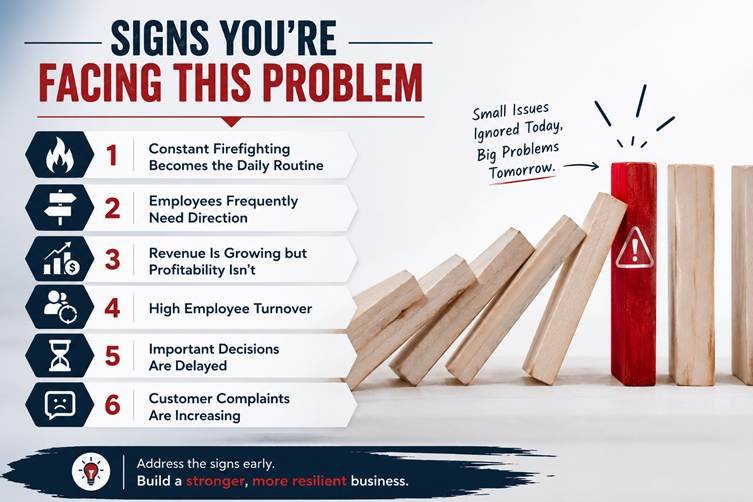
1. Constant Firefighting Becomes the Daily Routine
Last-minute complaints, missed deadlines, repeated mistakes — if this is just “a normal week,” something deeper is broken. You’re not running the business anymore. You’re just keeping it alive.
2. Employees Frequently Need Direction
What should I do next? Who owns this? What’s the priority? If your team asks these daily, it’s not a hiring problem. It’s a clarity problem. People can’t perform well inside a system that doesn’t give them direction.
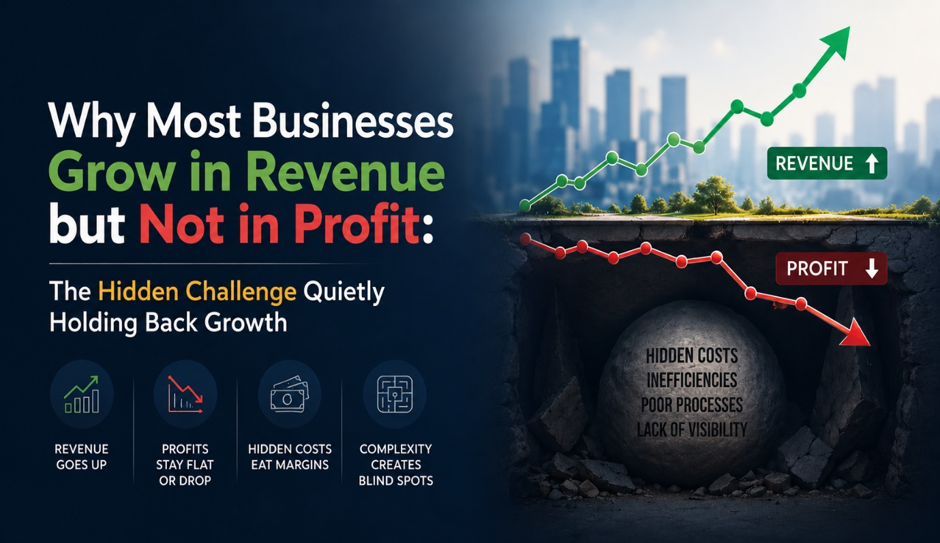
3. Revenue Is Growing but Profitability Isn’t
Celebrating revenue while margins quietly shrink is one of the most common traps in business. Unmonitored costs, growing inefficiencies, broken pricing — the money comes in, and somehow it disappears. That gap deserves attention.
4. High Employee Turnover
People don’t usually leave jobs. They leave the experience of working somewhere. When good people keep walking out, Gallup’s research points to the same culprits every time — poor communication, unclear expectations, feeling unsupported. All fixable. But only if you’re honest about it.
5. Important Decisions Are Delayed
Endless meetings. No clear owner. No decision. Meanwhile, the business waits. Slow decision-making isn’t careful — it’s costly. Bottlenecks don’t stay in one place; they spread.
6. Customer Complaints Are Increasing
Delayed responses, broken commitments, inconsistent service — customers experience the output of your internal problems, even when they can’t see them. And once your reputation starts slipping, winning it back takes far longer than protecting it would have.
Why This Happens
Poor management usually traces back to a few root causes:
Processes were never documented. Things work fine when a team is small and everyone just knows how it goes. Then the team grows, and suddenly nobody wrote anything down, and every person is doing things slightly differently.
The business outgrew the management style. What works for a 5-person team breaks at 20. What works at 20 breaks at 50. Growth requires evolving how you lead, not just how you sell.
Nothing is being measured. If you’re not tracking performance, profitability, or customer satisfaction in any structured way, problems can quietly grow for months before they’re visible.
Communication is informal. When people don’t have clear channels for updates, priorities, and feedback, things fall through the cracks constantly — not because anyone is careless, but because the system doesn’t support them.
What This Actually Costs You
It’s easy to treat management problems as inconveniences. But the real cost runs deeper:
Operational inefficiency eats into margins. Team confusion reduces output. Customer experience suffers. You, as the business owner, get trapped inside the day-to-day when you should be thinking about where the business is going.
And perhaps most importantly — without strong management systems, growth stops being exciting. It just means more chaos.
What You Can Actually Do About It
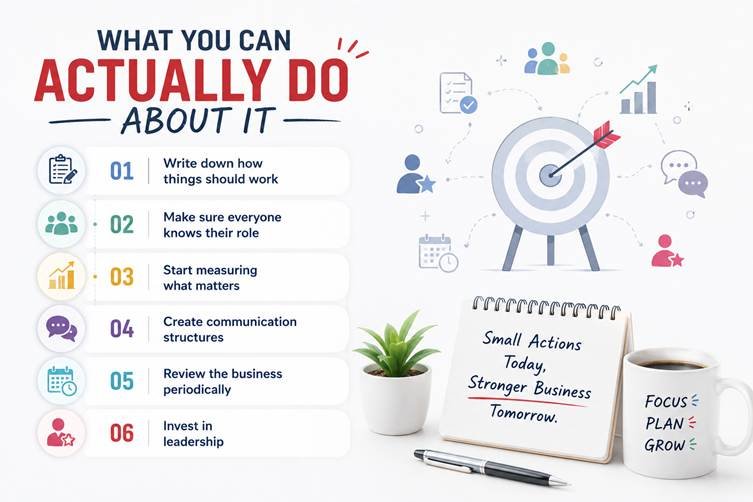
None of this requires starting over. It requires being intentional:
Write down how things should work. For your most repeated processes, document the steps. This alone eliminates a surprising amount of confusion.
Make sure everyone knows their role. Not in a bureaucratic way — just clearly. What does this person own? What does success look like for them? Who do they go to when they’re stuck?
Start measuring what matters. Revenue, margins, customer retention, team output — pick the metrics that tell you how the business is really doing, and look at them regularly.
Create communication structures. Regular team check-ins, clear reporting lines, a way for problems to surface before they become crises. These don’t have to be complicated. They just have to exist.
Review the business periodically. Step back. Look at what’s working, what isn’t, and where the bottlenecks are. Most problems are visible if you’re actually looking.
Invest in leadership. Your management capability is a skill. It develops with attention, feedback, and sometimes outside perspective.
How Rahuul Kumar Jain as India’s Leading Business Consultant can Help
Most business owners already know something’s off. They feel it — in the stress, the stalled growth, the sense that the business is running them instead of the other way around.
The hard part was never awareness. It’s knowing exactly what to fix, and where to start.
That’s where Rahuul Kumar Jain comes in.
- Finds what’s actually broken — not the symptoms you’re already frustrated by, but the root causes sitting quietly underneath them
- Builds systems that fit your business — not borrowed frameworks or generic advice, but practical solutions built around how your business actually works
- Brings the clarity that closeness takes away — when you’re inside the problem every day, it’s hard to see it clearly; an outside perspective cuts through that
- Keeps the focus on real outcomes — better margins, a team that doesn’t need constant hand-holding, operations that don’t rely on you to hold them together
- Works with you, not just on your business — the goal is a business that runs well on its own, not one that trades dependence on firefighting for dependence on a consultant
One of India’s most trusted business consultants, Rahuul Kumar Jain has helped owners go from exhausted and stuck to clear, structured, and growing.
If you can feel something’s wrong but can’t quite put your finger on it — that’s exactly where this conversation starts.
Poor management doesn’t fail businesses dramatically. It just quietly limits them — until growth stalls, good people leave, margins shrink, and the business owner finds themselves exhausted and stuck.
The warning signs are there long before the crisis. The businesses that catch them early, and take them seriously, are the ones that end up building something that actually lasts.
Ready to Take a Closer Look?
If any of this felt familiar, it might be time to get an outside perspective on what’s really going on in your business.
Connect with Rahuul Kumar Jain to work through what’s holding your business back — and build the clarity, systems, and structure to move forward.