The Airline That Fired a Customer
There’s a famous story from Southwest Airlines that I genuinely love telling people, because it breaks almost every rule of “good customer service” you’ve ever heard.
A woman flew with Southwest constantly, and she also complained constantly. Every single flight gave her something new to be upset about. No peanuts. A flight attendant who wasn’t cheerful enough. The boarding process. Eventually, she wrote in demanding the airline fix all of it.
Herb Kelleher, the airline’s co-founder, read her letter personally. Then he wrote back three words that have become legendary in business circles: “We will miss you.” He fired the customer (Big Think, reporting on Simon Sinek’s retelling of this story).
Southwest didn’t collapse after that. It went on to become one of the most loved, most profitable airlines in America, famous for its customer service. Which raises an obvious question. If “the customer is always right” is such good advice, why did one of the best customer service companies in the world openly ignore it?
Where This Whole Idea Even Came From
“The customer is always right” wasn’t handed down from some ancient business textbook. It came from a department store owner named Harry Gordon Selfridge, back in 1909, as a slogan to train his staff to treat shoppers well.
Here’s the part almost nobody mentions. By 1936, Selfridge’s own store had already softened the line. They changed it to “the customer is almost always right” (Compliant Ltd, business history archive). Even the man who popularised the original phrase eventually admitted it needed an asterisk.
Somewhere over the last hundred years, we dropped that asterisk completely, and small business owners have been paying for it ever since.
Why This Advice Actually Backfires
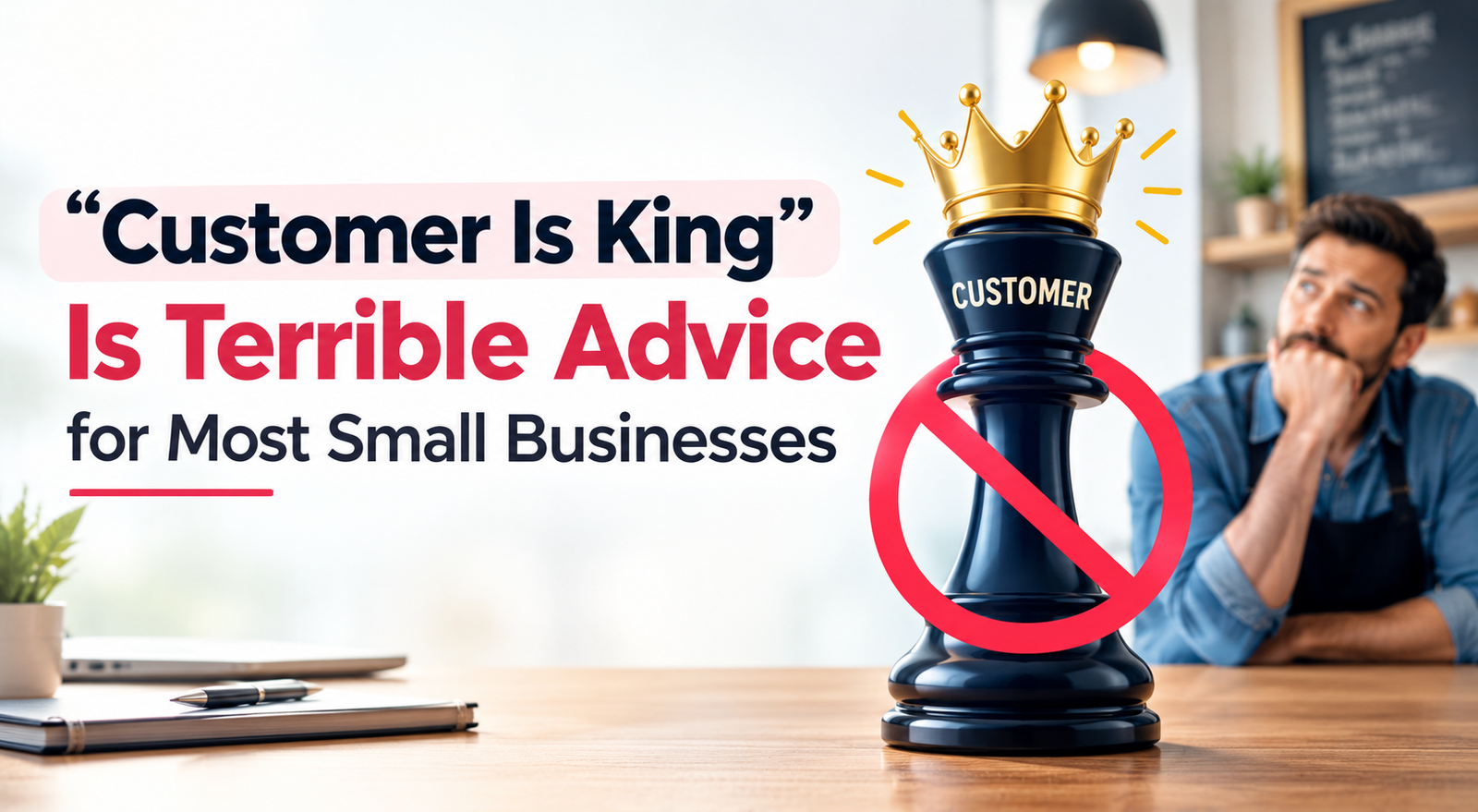
Here’s the simple, honest problem. If you tell your team “the customer is always right,” you’re also quietly telling them something else: when a customer is rude, unreasonable, or just plain wrong, you, the employee, don’t matter.
Think about what that actually does inside a small team.
- It normalises bad behaviour : Once “the customer is always right” becomes policy, a genuinely abusive customer technically can’t be wrong, by definition. That’s not customer service. That’s giving someone a license to mistreat your staff.
- It destroys trust in leadership fast : Workplace research has found that less than a third of employees actually believe their employer cares about their wellbeing (Laszlo Bock, LinkedIn, citing employee trust data). Nothing kills that trust faster than watching your boss side with a rude stranger over you, every single time.
- It wastes resources on the wrong people : A small number of difficult, unreasonable customers often eat up a disproportionate amount of time and energy, time that could’ve gone toward the customers who were never a problem in the first place.
- It burns out your best people quietly : Employees who feel unsupported during a bad customer interaction don’t usually quit on the spot. They just quietly stop caring, and that shows up in the quality of service everyone else gets.
For a big company, one unhappy employee might not move the needle much. For a small business, where every single team member matters enormously, this damage adds up fast.
The Companies That Prove the Opposite Works
Southwest isn’t alone here. Some of the most customer-loved brands on the planet openly reject the “customer first, always” idea, and it’s not despite their good service. It’s actually the reason behind it.
Richard Branson, who built Virgin into a massive global brand, has said plainly that he puts employees first and customers second, specifically because it leads to better customer service, not worse. His logic is simple: a team that feels genuinely respected and protected by leadership naturally treats customers better, without needing to be told to.
Costco runs on a similar philosophy. It’s consistently ranked among the best companies for customer satisfaction, while also being famous for paying its employees well above industry average and treating them with real respect. The two things aren’t a coincidence. They’re connected.
The pattern across all of these businesses is the same. Employees who feel protected and valued tend to protect and value customers right back, voluntarily, because they actually want to.
So What Should You Actually Do Instead?
None of this means you should ignore your customers or stop caring about service. It means replacing one bad, blanket rule with something far more useful.
Support your team publicly when a customer crosses a line : If someone is genuinely rude or abusive to your staff, that’s not a “customer service opportunity.” That’s a moment to visibly back your employee, even if it costs you that one sale.
Accept that some customers are simply bad for your business : A customer who constantly demands discounts, wastes your team’s time, or treats your staff poorly isn’t someone you need to keep chasing. Sometimes the most profitable decision is politely letting them go.
Separate “the customer deserves to be heard” from “the customer is automatically correct.” : Every complaint deserves a fair hearing. Not every complaint deserves to be treated as fact.
Set honest boundaries, and actually stick to them : A clear return policy, a clear scope of service, a clear idea of what you will and won’t bend on. Boundaries don’t push good customers away. They push away the ones who were never going to be worth keeping anyway.
Hire and train for judgment, not just compliance : The best customer-facing employees aren’t the ones blindly following a script. They’re the ones trusted to tell a genuine mistake apart from someone trying to take advantage.
Where the Old Advice Still Gets Something Right
To be fair, there’s a reason this phrase lasted a hundred years. Customers genuinely do deserve respect, patience, and a real effort to solve their problems. A business that ignores legitimate complaints, or treats every unhappy customer as the enemy, will fail just as quickly as one that bends over backwards for everyone.
The real fix isn’t swinging to the opposite extreme. It’s dropping the word “always.” Most customers are reasonable, and they deserve real care. A small number aren’t, and pretending otherwise is what actually damages your business, your team, and ironically, your service quality too.
The Real Lesson Here
“The customer is always right” survives because it sounds nice, short, and simple. But a hundred years after it was first printed on an advertisement, even the man who popularised it had already quietly walked it back.
If you run a small business, your team is often your biggest asset and your smallest resource at the same time. Protecting them properly isn’t disloyalty to your customers. It’s usually exactly what makes your customer service worth talking about in the first place.
As a business consultant in Jaipur working with small business owners and founders, this is genuinely one of the most common mindset shifts I help people make. Not because customers don’t matter. Because a business that runs purely on “the customer is always right” usually burns out its own people long before it ever builds something that lasts.
If you’re rethinking how your business treats both your team and your customers, and want an honest outside perspective on getting that balance right, I’m Rahuul Kumar Jain, and I’d genuinely enjoy that conversation with you.