As a business owner, there comes a point when hard work alone is no longer enough.
You may be putting in long hours, managing customers, solving team issues, handling finances, and making every important decision—yet growth still feels slow or uncertain. At that stage, external guidance can make a meaningful difference.
Two terms often come up: business coach and business consultant.
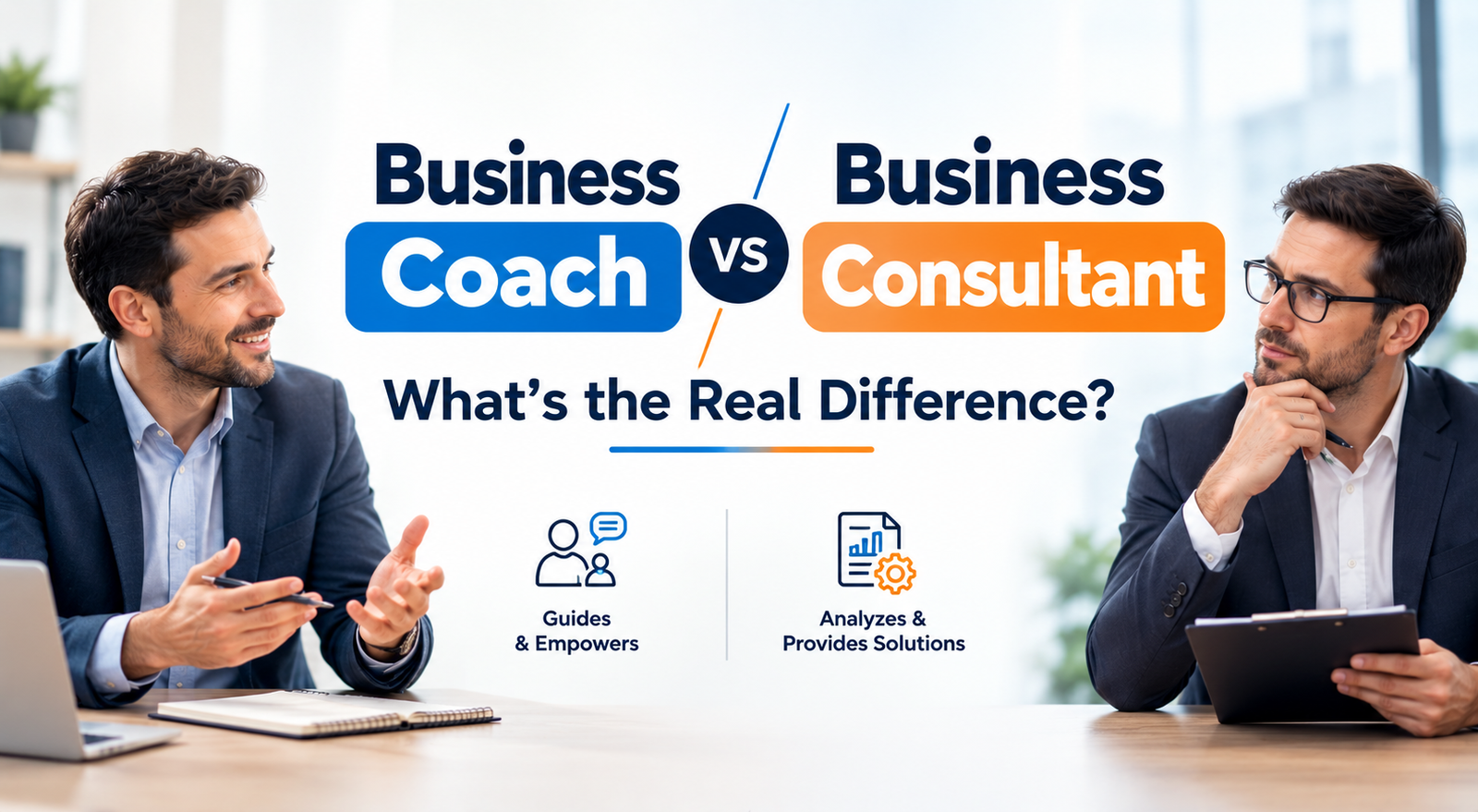
While people frequently use them interchangeably, they serve different purposes. A business coach helps the entrepreneur or leader become more effective. A business consultant helps the business solve a specific problem through expert analysis, advice, and solutions.
Understanding the difference can help you invest in the support that will create the greatest impact for your business.
The Core Difference
The simplest way to understand the distinction is this:
A business coach focuses on you as the leader.
A business consultant focuses on the business challenge.
The International Coaching Federation describes coaching as a partnership that uses a thought-provoking and creative process to help clients maximise their personal and professional potential. In business, this means a coach helps entrepreneurs develop clarity, confidence, leadership ability, focus, and accountability. (Source: International Coaching Federation)
Management consulting, on the other hand, involves providing management with objective advice and assistance related to business strategy, structure, operations, and other management challenges. (Source: Institute of Management Consultants USA)
In practical terms:
- A business coach helps you think better, lead better, and execute consistently.
- A business consultant helps you identify, analyse, and solve a particular business issue.
- A coach asks questions that help you discover your own answers.
- A consultant uses expertise to recommend a course of action.
- A coach builds your long-term leadership capability.
- A consultant helps improve a specific business function, process, or outcome.
Neither is better in every situation. The right choice depends on what is stopping your business from moving forward.
What Does a Business Coach Do?
A business coach works with founders, entrepreneurs, business owners, and senior leaders who want to improve the way they lead and grow their business.
The purpose of coaching is not merely to give advice. It is to help the business owner create clearer thinking, stronger habits, better decisions, and consistent action.
A business coach can help you:
- Clarify your long-term vision and business goals
- Identify your most important priorities
- Make confident decisions during uncertainty
- Improve focus and avoid constant firefighting
- Build better leadership and communication skills
- Delegate effectively and stop micromanaging
- Create accountability around key business goals
- Improve time management and personal discipline
- Navigate difficult conversations with employees, partners, or clients
- Move from working in the business to working on the business
For example, imagine a founder who is involved in every small decision. Employees wait for approval, managers lack authority, and the founder has no time to focus on growth.
The issue may not be a lack of systems alone. The deeper challenge could be difficulty trusting the team, fear of losing control, or uncertainty about delegation.
A business coach can help the founder identify these patterns, develop a better leadership approach, set delegation goals, and stay accountable while making the transition.
This reflects the coaching principle of helping clients generate their own insights, strategies, and solutions rather than simply receiving instructions. (Source: International Coaching Federation)
What Does a Business Consultant Do?
A business consultant is generally hired to solve a defined business challenge or improve a specific area of the organisation.
Consultants bring external perspective, specialist knowledge, structured analysis, and practical recommendations. They study the situation, identify what is not working, and recommend what should change.
A business consultant may help with:
- Sales strategy and sales process improvement
- Marketing audits and lead-generation planning
- Pricing and profitability improvement
- Cost reduction and financial analysis
- Operational efficiency and process improvement
- Standard operating procedures and system development
- Team structure and organisation design
- Market-entry strategy
- Customer experience improvement
- Technology implementation
- Business restructuring or turnaround planning
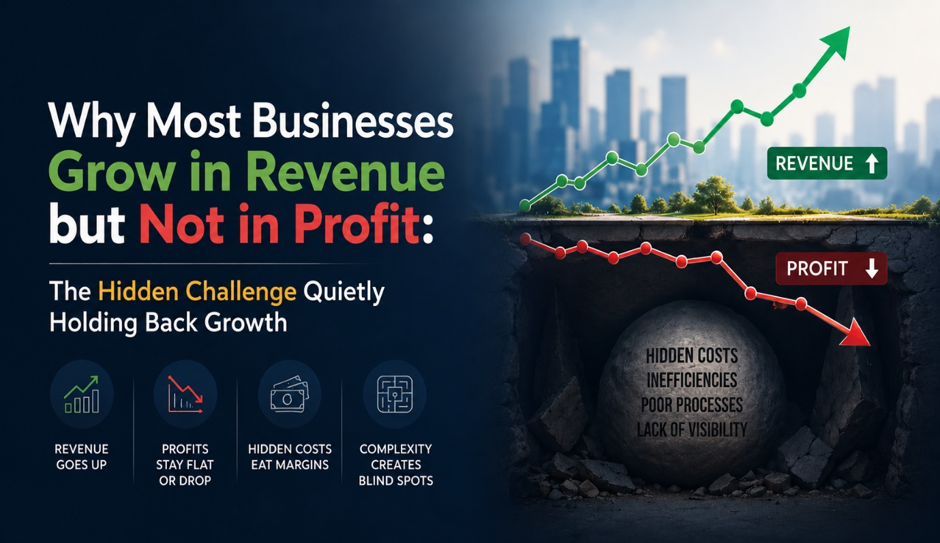
For instance, imagine a company with strong revenue but declining profits. A consultant can examine pricing, supplier costs, inventory, staffing, production efficiency, and delivery processes to identify why margins are falling.
The consultant can then recommend specific changes, such as improving pricing, reducing waste, restructuring processes, or renegotiating supplier arrangements.
The Institute of Management Consultants describes management consulting as objective advice and assistance for management challenges; this can include identifying options, making recommendations, and helping with implementation. (Source: Institute of Management Consultants USA)
Business Coach vs. Business Consultant
| Area | Business Coach | Business Consultant |
| Primary focus | The entrepreneur, founder, or leader | A specific business challenge or opportunity |
| Main objective | Improve clarity, leadership, focus, and accountability | Diagnose issues and provide expert solutions |
| Typical approach | Questions, reflection, challenge, support, and accountability | Analysis, expertise, recommendations, and implementation |
| Who creates the solution? | The business owner, guided by the coach | The consultant brings specialist recommendations |
| Engagement style | Usually ongoing and developmental | Often project-based or scope-based |
| Common outcome | Better decisions, stronger leadership, improved execution | A strategy, process, system, roadmap, or measurable improvement |
| Best suited for | Leaders who want sustainable growth and capability | Businesses facing a clear functional or operational problem |
| Role of accountability | Usually central to the engagement | Depends on the agreed project scope |
The key distinction is that coaching strengthens the leader’s ability to handle challenges over time, while consulting applies expertise to solve a defined business problem. (Source: International Coaching Federation; Institute of Management Consultants USA)
When Should You Hire a Business Coach?
A business coach may be the right choice when your biggest challenge is not a lack of information, but a lack of clarity, confidence, consistency, leadership, or accountability.
Consider hiring a business coach if:
- You know what needs to be done but keep postponing it.
- You feel overwhelmed by too many priorities.
- You are always busy but not making meaningful progress.
- You struggle to make important business decisions.
- You find delegation difficult.
- Your team depends on you for every decision.
- You want to become a more confident leader.
- You need an independent sounding board.
- You want accountability for your goals and commitments.
- You are moving from entrepreneur mode to CEO mode.
- You want growth without constant stress and burnout.
For example, you may already know that you need to hire a manager, raise your prices, create better systems, or improve team accountability.
However, knowledge does not always lead to action.
The real obstacle may be fear of making the wrong choice, lack of follow-through, poor prioritisation, or a habit of focusing only on urgent daily tasks. A business coach helps you address these patterns so that you can lead your business more effectively.
When Should You Hire a Business Consultant?
A business consultant is often the better fit when you have a defined issue that needs expertise, analysis, and a practical plan.
Consider hiring a business consultant if:
- Sales are declining and you need to understand why.
- Your marketing efforts are not generating qualified leads.
- Profit margins are falling.
- Your operations are inefficient or disorganised.
- You need better systems and standard operating procedures.
- You are launching a product or entering a new market.
- You need help with pricing, finance, sales, HR, technology, or operations.
- You need an external expert to objectively assess the business.
- You need a clear strategy, roadmap, and implementation plan.
- Your internal team does not have the knowledge required for a major project.
For example, if your website gets visitors but produces very few enquiries, a marketing consultant can review the website journey, messaging, landing pages, calls to action, advertising campaigns, analytics, and lead follow-up process.
In this situation, the business needs more than motivation or accountability. It needs expert diagnosis and a structured solution.
How to Choose Between Them
The most useful question is not, “Which one is better?”
The right question is, “What problem do I need to solve right now?”
Choose a business coach when you need growth from within
A business coach is likely the better choice if your challenge involves leadership, mindset, decision-making, focus, confidence, or accountability.
You may need a coach if you find yourself saying:
- “I know what I should do, but I am not doing it.”
- “I feel unclear about my direction.”
- “I spend all my time solving daily problems.”
- “My team relies on me too much.”
- “I need to become a better leader.”
- “I need someone to challenge my thinking.”
- “I have goals, but I cannot stay consistent.”
Choose coaching when the biggest change needs to happen in the way you think, lead, communicate, or execute.
Choose a business consultant when you need expert answers
A consultant is likely the better choice if the business has a clear challenge that requires specialised knowledge.
You may need a consultant if you find yourself saying:
- “We need to improve our sales process.”
- “Our profit is falling, and we do not know why.”
- “Our marketing is not generating enough leads.”
- “We need stronger processes and systems.”
- “We are planning to enter a new market.”
- “We need help with pricing or financial planning.”
- “We need someone who has solved this problem before.”
Choose consulting when you need expert analysis, recommendations, and a structured plan to improve a specific area of the business.
Quick Decision Guide
| If you are thinking… | You may need… | Why |
| “I know what I should do, but I am not doing it.” | A business coach | You may need accountability, confidence, and behavioural change |
| “I am unclear about my direction and priorities.” | A business coach | You may need stronger thinking, focus, and decision-making |
| “My team depends on me for every decision.” | A business coach | You may need leadership and delegation support |
| “Our sales process is weak.” | A business consultant | You may need a sales audit, strategy, and structured process |
| “Our profits are falling despite healthy sales.” | A business consultant | You may need financial and operational analysis |
| “We want to expand into a new market.” | A business consultant | You may need market knowledge, strategy, and implementation support |
| “We have a strategy but struggle to execute it.” | Often both | Consulting can strengthen the plan; coaching can strengthen leadership and accountability |
| “I want to grow without burning out.” | A business coach | You may need better habits, priorities, and leadership practices |
Can You Use Both?
Yes. In fact, many business owners benefit from using both at different stages of their journey.
A consultant can help you understand a problem, create a strategy, improve a system, or design a roadmap.
A coach can help you lead the change, manage your team through the transition, make decisions with confidence, and remain accountable to implementation.
For example, a consultant may create a new sales process for your business. But that process will only deliver results if your team adopts it, managers track performance, responsibilities are clear, and you stay committed to the new way of working.
The consultant provides the business solution.
The coach helps you develop the leadership required to make the solution work.
Final Thoughts
Business coaching and business consulting are both valuable, but they create value in different ways.
A business coach helps you become a more focused, confident, accountable, and effective leader.
A business consultant helps your organisation solve specific challenges using analysis, experience, recommendations, and implementation support.
If you need a solution to a clear business problem, a consultant may be the right fit.
If you need to improve how you lead, decide, and execute, a coach may be the right fit.
And if you need both a stronger strategy and stronger leadership, combining coaching and consulting can give your business the support it needs to grow with greater clarity, confidence, and purpose.