
Introduction
There’s a moment most business owners know but rarely talk about.
Sales are up. New customers are coming in. The numbers on the dashboard look like things are finally working. And yet — you check your bank account, and something doesn’t add up.
That gap between what you’re earning and what you’re actually keeping? It’s more common than you’d think. And honestly, it’s one of the loneliest feelings in business — because from the outside, everything looks fine.
The truth is, you can double your revenue and still feel completely broke. That’s not a failure of effort. It’s usually a failure of understanding one simple but crucial distinction: revenue and profit are not the same thing.
Revenue is everything that comes in. Profit is what stays after you’ve paid for everything it took to get it here. Real growth means keeping a healthy relationship between both — and far too many businesses are growing one while quietly neglecting the other.
What’s Actually Happening
Think of revenue as your “top line” — the total of everything your business earns before a single expense is touched. Profit is the “bottom line” — what’s left standing after salaries, rent, tools, marketing, taxes, and every other cost has taken its cut.
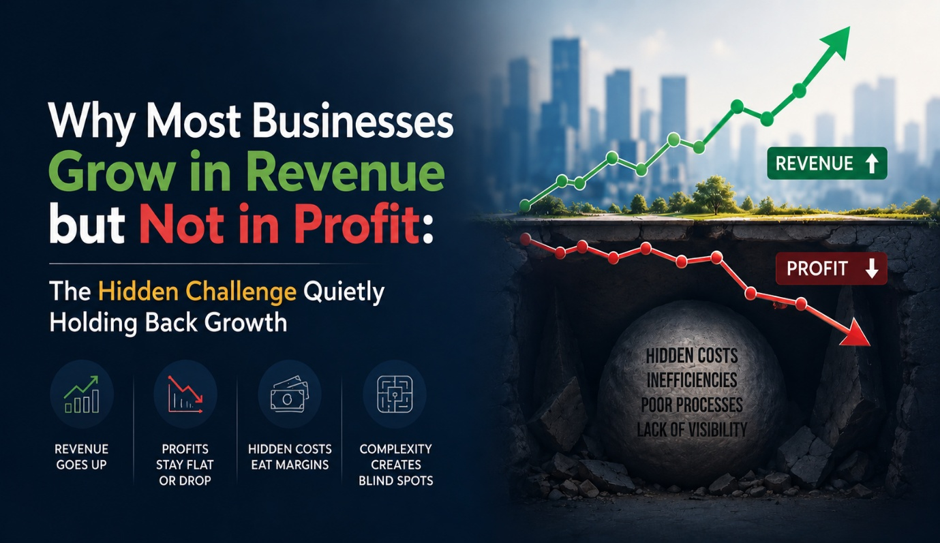
Here’s where it gets uncomfortable: a business can post strong sales growth every single quarter and still watch profits stagnate — or shrink — if costs are quietly growing faster in the background.
Picture this scenario:
- Revenue climbs by 30%
- Marketing spend climbs by 40%
- Payroll grows by 25%
- Operational costs tick up by 20%
On paper, you’re growing. In your bank account, you’re treading water — or worse.
How Do You Know If This Is You?
Most business owners don’t spot this pattern until it’s already baked into their operations. A few honest signals worth paying attention to:
Cash feels tight even when sales are strong. Things are moving — but whenever you need cash for something real, it’s somehow never there.
Your savings aren’t growing the way they should. The business looks successful from the outside. Your financial cushion tells a different story.
Every month feels like a sprint just to stay even. There’s no sense of compounding, no feeling that you’re building momentum. Just constant pressure to keep generating.
Your margins are slowly shrinking. You’re selling more, but each sale is quietly worth a little less than it used to be.
Complexity is increasing, reward isn’t. More people, more processes, more decisions — without a matching improvement in what you actually take home.

Why This Happens to Good Businesses
This isn’t about lazy owners or bad products. It happens to hardworking, intelligent people all the time. Here’s why:
The obsession with top-line growth. When the whole team is focused on revenue, profitability becomes an afterthought. Discounts, promotions, and race-to-the-bottom pricing can fill the funnel while quietly draining what each sale is worth.
Growth costs money — often more than expected. New hires, software subscriptions, expanded operations, more customer support. These costs are natural. The problem is when they outpace the revenue they’re supposed to support.
Pricing that was set years ago and never revisited. Staying cheap to stay competitive might feel safe. But it often leaves no room for a healthy margin — and no margin means no cushion for anything.
Customer acquisition keeps getting more expensive. Digital advertising is not what it was five years ago. When the cost to win a customer creeps past the value that customer brings, every new sale quietly works against you.
Inefficiency hiding in plain sight. Manual processes, duplicated effort, outdated systems — these create real costs that nobody is measuring until they’ve already compounded.
Selling the wrong mix of things. Not everything you offer contributes equally to your bottom line. Many businesses spend most of their energy on high-volume, low-margin work, while their most profitable offerings barely get attention.
What It Costs You Over Time
This isn’t just a financial problem. It ripples.
When profit can’t keep pace with revenue, covering day-to-day costs becomes genuinely stressful. Expansion starts to feel like a risk instead of an opportunity. A single bad quarter can threaten stability. And the owner — who’s working harder and managing more complexity than ever — starts to wonder if it’s all worth it.
There’s also a longer-term cost people underestimate: a business’s value. Investors and buyers don’t just look at revenue. They look at profitability. A modestly-sized but highly profitable business will almost always command a higher valuation than a larger one with weak margins.
What You Can Actually Do About It
None of this requires a dramatic overhaul. It starts with clarity.
Get honest about what’s actually making you money. Go product by product, service by service, customer segment by customer segment. Some of what you’re selling is working hard for you. Some of it is working against you. You need to know which is which.
Revisit your pricing. Seriously — when did you last review it? Your prices should reflect your real costs, your real value, and what the market will actually support. Even modest adjustments can have a meaningful impact on your margins.
Track the numbers that actually matter. Not just revenue — gross profit margin, operating profit margin, net profit margin, customer acquisition cost, customer lifetime value. These are the metrics that tell you where profit is quietly slipping through the cracks.
Find the inefficiencies. Automate what can be automated. Cut what’s genuinely wasteful. Operational improvements often do more for your bottom line than any new sales push.
Change the question you’re asking. Instead of “How do we increase sales?” start asking “How do we increase profitable sales?” That one shift in framing leads to fundamentally smarter decisions across the board.

Working With Rahuul Kumar Jain
Understanding the problem intellectually is one thing. But sitting with the stress of it — watching your revenue climb while your bank account tells a different story — that’s something else entirely.
That’s exactly the situation Rahuul Kumar Jain built his work around.
He doesn’t show up with a generic playbook or a slide deck full of frameworks you’ve already seen. He sits down with your actual numbers, your actual operations, and your actual business — and gets to work finding what’s really going on beneath the surface.
What working with him actually looks like:
- Finding where your profit is quietly disappearing — Sometimes it’s a pricing decision that never got revisited. Sometimes it’s a process that made sense early on but became a liability as things grew.
- Fixing the pricing problem most people are afraid to touch — Under pricing feels safe until you’re working harder than ever and still not keeping enough of what you earn. The work is about charging what you’re actually worth.
- Cutting through operational complexity — The bigger a business gets, the more it accumulates — extra steps, redundant tools, processes nobody remembers starting. The goal is to strip that back so things run cleaner.
- Building a growth strategy that doesn’t eat its own margins — Growth that costs more than it returns isn’t growth, it’s just motion. The focus is on building a path that’s designed around profitability from the start.
- Getting clear on what you should actually be selling more of — Some of what you offer is genuinely profitable. Some of it is keeping you busy without keeping you ahead — and the two can look identical until someone looks closely.
- Making smarter decisions about cost — It’s about understanding which costs are building something real and which ones are simply drag — that distinction changes everything.
- Making the whole operation easier to run — Not just more profitable on paper, but genuinely easier to manage — so growth doesn’t come at the cost of your time or peace of mind.
The strategy matters. But what makes the difference is someone who stays in it with you until the change is real — not just planned, not just presented, but actually showing up in your numbers.
That’s what Rahuul Kumar Jain brings to the table.
The Bottom Line
Impressive revenue figures mean very little if rising costs, operational drag, and underpriced work are quietly eating away at everything you earn.
The businesses that last aren’t just focused on selling more. They’re focused on selling smarter — making sure that growth actually shows up where it matters.
Ready to Find Out Where Your Profit Is Going?
If your business is generating more revenue but not delivering the profits you expected, it might be time to look under the hood.
Connect with Rahuul Kumar Jain to uncover what’s holding your margins back — and build a path to growth that’s genuinely sustainable.