The Plane That Never Should Have Flown
In the 1960s, Britain and France teamed up to build something incredible. A supersonic passenger plane called the Concorde, fast enough to cross the Atlantic in under four hours.
Partway into the project, something became clear to almost everyone involved. The plane was never going to make financial sense. The costs were too high. The market was too small. Experts on both sides quietly knew it was a losing bet.
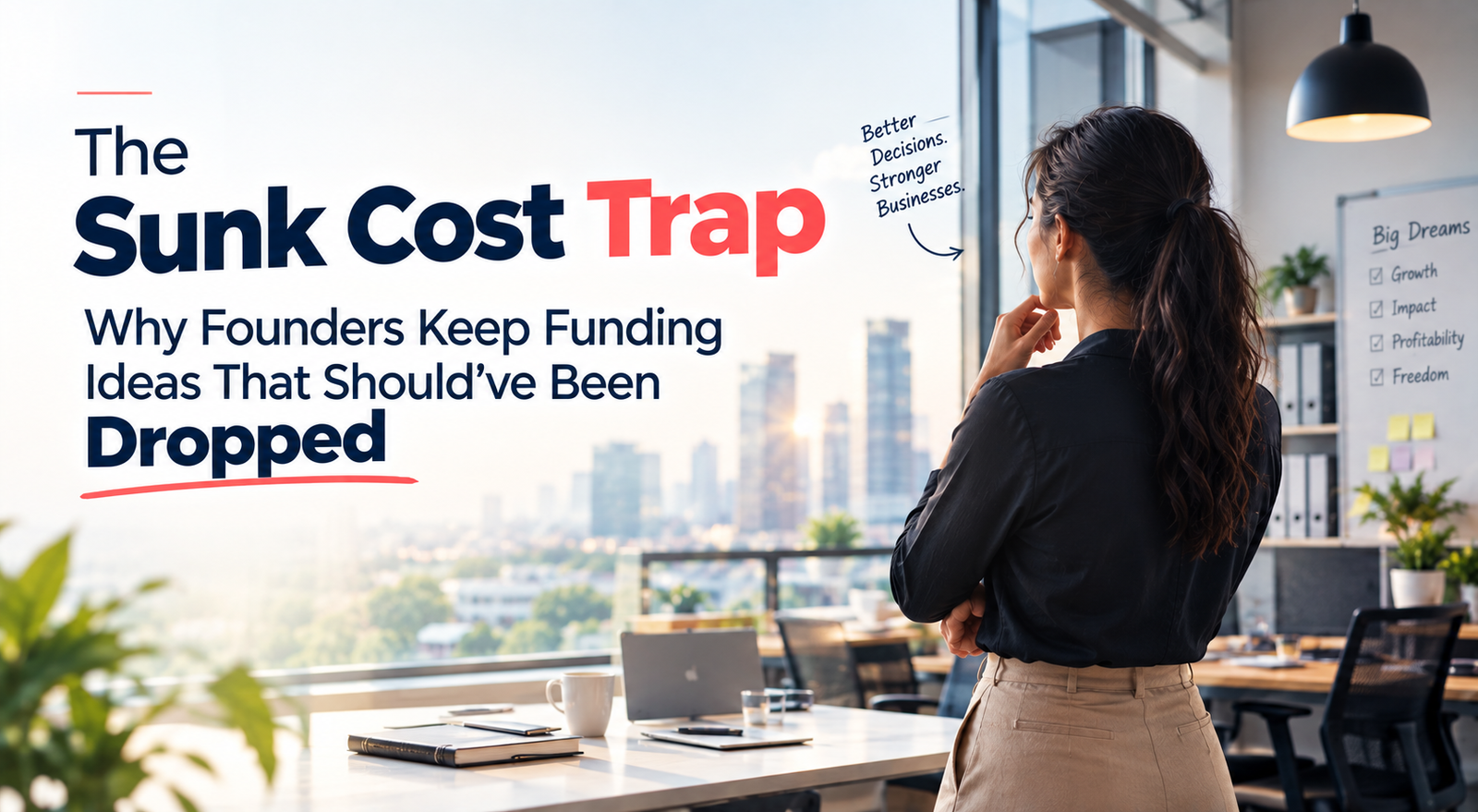
And yet, both governments kept pouring money into it anyway. For years. The project became so famous for this exact behaviour that economists later gave it its own name: the Concorde fallacy, now more commonly called the sunk cost fallacy. (Source: Asana, Sunk Cost Fallacy overview, 2026)
Here’s the strange part. The reasoning behind the decision wasn’t really about the plane’s future at all. It was about the money already spent. “We’ve already put so much into this. We can’t stop now.” That single sentence, repeated in boardrooms and government offices alike, is one of the most expensive sentences in business history.
And founders say some version of it to themselves almost every single week.
What the Sunk Cost Fallacy Actually Means
Here’s the simple version. A sunk cost is money, time, or effort you’ve already spent, and can never get back, no matter what you decide next.
The fallacy happens when that already-spent cost influences a decision it has no real business influencing. The money is gone either way. The only real question left is, “what’s the smartest thing to do from this point forward?” But our minds don’t naturally think that way. They keep glancing backward at what’s already been spent, and let that shape what happens next.
An economist named Richard Thaler was among the first to study this properly, showing that people tend to keep using something simply because they’ve already paid for it, even when it no longer makes sense to (Source: Richard Thaler, 1980). Later, researchers Hal Arkes and Catherine Blumer ran a series of experiments that showed this pattern clearly and consistently (Source: Arkes & Blumer, Organizational Behavior and Human Decision Processes, 1985).
In plain words, their research confirmed what the Concorde story already showed. Once we’ve invested in something, we find it incredibly hard to walk away, even when every sign points to walking away being the right call.
Why This Trap Is So Easy to Fall Into
If this sounds obviously irrational when you read it written out plainly, you’re right. It is. And yet almost everyone falls into it anyway, founders especially. Here’s why.
Walking away from something you’ve invested in feels like admitting failure, even when it isn’t. It feels less like “I made a smart decision to stop” and more like “I wasted all that time and money.” That emotional sting is often strong enough to override good judgment entirely.
There’s also a kind of personal identity wrapped up in business decisions that doesn’t exist in most other areas of life. A founder who started a product, hired for it, promoted it, and told investors or family about it, has a lot more riding on that decision than just money. Walking away can feel like walking away from a part of your own story, not just a business line item.
And finally, there’s a quieter, more practical reason. Stopping something requires a hard conversation. Telling a team a project is being shut down. Telling a client a service is ending. Admitting to yourself that a decision from two years ago didn’t work out. It’s almost always easier, in the short term, to just keep going.
What This Actually Looks Like in a Business
The sunk cost trap rarely shows up as a huge, dramatic decision. It usually hides inside small, ordinary ones.
A founder keeps funding a product line that’s been losing money for two years, because “we’ve already invested so much in building it.” A business owner keeps an underperforming employee on the team, not because they’re a good fit, but because of how much time and training already went into them. A company keeps a difficult, low-paying client around, simply because of how long the relationship has already lasted, even though the client takes up more time and energy than they’re actually worth.
None of these decisions get made in one dramatic moment. They get made slowly, month after month, each time feeling like a small, reasonable choice to just wait a little longer and see.
A Second Example, Closer to Everyday Business
The Concorde is a dramatic, government-sized example, so it’s worth looking at something closer to ordinary business too.
Kodak, the photography company, actually invented one of the first digital cameras back in the 1970s. But the company had spent decades building an enormous, hugely profitable business around film and chemical processing. Shifting fully toward digital would have meant walking away from that massive existing investment, so leadership kept leaning on their traditional film business for far longer than the market actually supported. By the time Kodak took digital photography seriously, competitors who had no old investment to protect had already moved far ahead. (Source: Harvard Business School, Kodak case study archives)
This is the same pattern as the Concorde, just playing out over decades instead of years, and inside a business instead of a government project. The deeper and older the investment, the harder it becomes to walk away from it, even when the signs pointing the other direction are sitting in plain sight the whole time.
A Simple Way to Spot It in Yourself
Here’s a genuinely useful trick, the kind that actually works in the middle of a real decision, not just in theory.
Ask yourself this question honestly: “If I were starting fresh today, knowing everything I know now, would I choose to begin this?” Not continue it. Begin it, from zero.
If the honest answer is no, that’s usually sunk cost thinking at work, quietly keeping you attached to a decision made by a version of you with less information than you have right now. The money, time, or effort already spent genuinely has no bearing on what the smartest next step is. It’s already gone either way.
This question works because it strips away the emotional weight of everything already invested, and forces you to judge the decision purely on what’s actually in front of you today.
It’s Not Always Wrong to Keep Going
I want to be fair here, because this isn’t a call to abandon anything that’s struggling.
Some projects genuinely need more time before they pay off. Some employees need more training, not less. Some client relationships are worth patience while things improve. The sunk cost trap isn’t about always quitting quickly. It’s about making sure your reason for continuing is based on real, current evidence that things are actually working, not simply on how much has already been spent.
The real test is this. If your main reason for continuing is “we’ve come this far,” that’s a warning sign. If your reason is “the current numbers and signals genuinely still look good,” that’s a completely different, much healthier reason to keep going.
How to Build Better Habits Around This
A few practical things that genuinely help, based on what I’ve seen work with business owners facing exactly this kind of decision.
Set a review point in advance, before emotions get involved. Decide upfront, when you launch something new, exactly when you’ll honestly review whether it’s working. Doing this before you’re emotionally attached to the outcome makes the eventual decision far easier.
Bring in someone outside the decision. It’s almost always easier for someone without money or ego tied up in a decision to see clearly whether it’s working. That’s often exactly why an outside perspective, like a consultant or an honest advisor, catches things a founder standing too close to the decision simply can’t.
Separate the decision from the person who made it. A lot of founders struggle to kill their own idea, because it feels personal. Try asking, “if my most trusted colleague had started this, what would I honestly tell them to do?” Sometimes that small shift in framing makes the right answer much easier to see.
Write down what success was actually supposed to look like at the start. Many sunk cost decisions survive simply because nobody clearly remembers what the original goal even was. If you had a clear target when you started, it’s a lot harder to quietly keep moving the goalposts to justify staying in.
Accept that stopping is a decision, not a failure. The Concorde project eventually did stop, years after it should have. Stopping something that isn’t working isn’t the failure. Continuing it long after the evidence was clear, that’s the actual failure.
Why This Matters So Much for Small Businesses
A big company can often absorb a failed project quietly, without anyone outside really noticing. A small business usually can’t. Every rupee tied up in something that isn’t working is a rupee that can’t go toward something that might actually succeed.
This is exactly why learning to recognise sunk cost thinking matters more for small business owners, not less. You have fewer resources to waste holding onto decisions simply because you’ve already invested in them.
Think about it in very practical terms. If a large company sinks ₹50 lakh into a failed product line, it’s a disappointing quarter. If a small business sinks the same amount into something that isn’t working, it can be the difference between a business that survives the year and one that doesn’t. The stakes aren’t just bigger in percentage terms for a small business. They’re often existential in a way they simply aren’t for a larger company with more room to absorb a mistake quietly.
Where I Help With This
As a business consultant in Jaipur, a business coach in Jaipur, and a growth strategist in Jaipur working with founders across different industries, this is one of the most common, quietly expensive patterns I help clients actually see clearly in their own business.
It’s genuinely hard to see this pattern in yourself, precisely because the emotional pull of “we’ve already come this far” is strongest exactly when you’re the one who made the original decision. That’s often where an outside, honest perspective becomes genuinely useful, not to make the decision for you, but to ask the one simple question you’ve been avoiding asking yourself.
If there’s a decision in your business you suspect you’re holding onto for the wrong reasons, I’m Rahuul Kumar Jain, and I’d genuinely be glad to help you think it through honestly.
The Real Takeaway
The money, time, and effort you’ve already spent on something is gone, whether you continue or stop today. That part of the decision was made a long time ago, and nothing you do now changes it.
The only real question left is simple, even if it doesn’t always feel that way in the moment. Looking only at today, with everything you now know, is this still the right path forward?
If the honest answer is yes, keep going with real confidence. If the honest answer is no, remember the Concorde. The plane that never should have flown, and the lesson it left behind for every founder who’s ever quietly said, “we’ve come too far to stop now.”