You are running your business. Day after day, you handle customers, manage your team, chase payments, and try to keep everything together. Growth feels slow. Profits are tight. You know your business can do better, but you are not sure what to change.
Then you start noticing other businesses that seem to be growing fast.
You watch a restaurant fill up every weekend with a particular theme, menu, and marketing style. You see a retail brand scaling with a specific kind of store design, pricing, and promotions. You follow a coaching business or service provider that is getting consistent leads and sales using a particular offer, funnel, and content strategy.
Everything looks so clear from the outside.
You think, “They are growing with this strategy. If I do something similar, my business will also grow.”
So you decide to follow their path.
You launch a similar offer. You copy their funnel. You imitate their marketing style. You even redesign your website or store to look more like theirs. You invest time, money, and energy into building what you believe is a “proven model”.
But after a few weeks or months, the results are not what you expected.
Leads are weak. Sales are inconsistent. Customers are not responding the way you hoped. Your team is confused. You are frustrated. And slowly, a question starts forming in your mind:
“If they could grow with this, why can’t I?”
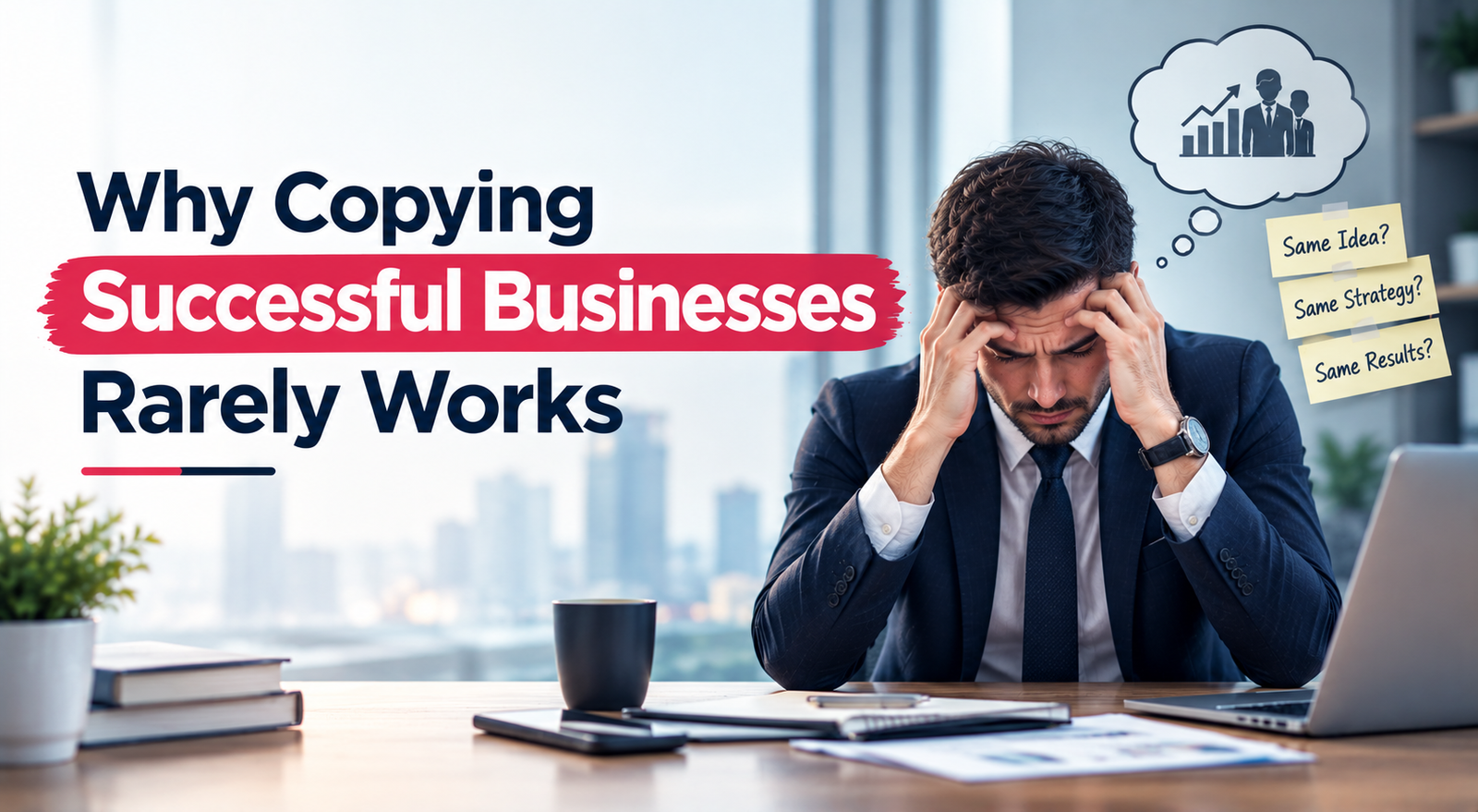
The answer is not that you are incapable. The answer is that copying successful businesses rarely works the way most business owners expect.
This blog is written for entrepreneurs like you—who have tried following someone else’s strategy and wondered why it did not deliver the same results. It explains why this happens, what actually drives sustainable growth, and how working with the right business consultant, growth strategist, or business coach can help you build a strategy that truly fits your business.
The Moment You Decide to Copy
As a business owner, you are constantly looking for answers.
You attend workshops. You watch webinars. You follow successful entrepreneurs on social media. You read case studies. You talk to other business owners.
And then you see it: a business that looks like it has “cracked the code”.
Maybe it is a brand that has scaled quickly with a particular positioning. Maybe it is a national brand with a strong online presence. Maybe it is a local service business that seems to have endless enquiries.
Their strategy looks simple and repeatable:
- A clear offer
- A specific way of marketing
- A defined customer segment
- A particular pricing model
- A visible growth trajectory
Your mind starts connecting the dots.
“They are doing this and growing. I will do something similar. It should work for me too.”
So you make a decision.
You decide to follow their strategy. You adapt their offer. You model their funnel. You copy their messaging style. You invest in similar ads, similar creatives, and similar campaigns.
For a while, you feel hopeful. You believe you have finally found the path.
But reality hits differently.
What You See vs. What You Do Not See
When you look at a successful business, you see the final version of their strategy.
You see:
- Their current offer
- Their current branding
- Their current marketing channels
- Their current team structure
- Their current results
What you do not see is the journey behind it.
You do not see:
- The earlier offers that failed
- The marketing experiments that did not work
- The wrong hires and bad decisions
- The years of learning and iteration
- The specific market conditions that favoured them
- The unique strengths of their founder and team
- The relationships and networks they built over time
- The capital, resources, or advantages they had
You also do not see the hidden systems that make their strategy work:
- How they follow up with leads
- How they train their sales team
- How they handle customer complaints
- How they measure performance
- How they adapt when something stops working
As a business owner, you copy what is visible. But success is often built on what is invisible.
A business consultant will tell you this often: two businesses can use the same tactic, but get completely different results because their internal capabilities and context are different.
Why Your Business Is Not Their Business
You and the business you are copying may be in the same industry, but you are not the same business.
Your context is different.
Consider:
- Your market: Customer behaviour, price sensitivity, and competition vary from city to city and even within the same city. A strategy that works in one area may not work in another.
- Your customer segment: Your ideal customer may have different income levels, preferences, and buying habits compared to the business you are copying.
- Your team: Your team’s skills, experience, and capacity may be different. They may need more training, clearer processes, or a different management style.
- Your strengths: You may be stronger in relationships, operations, or product quality, while the other business may be stronger in branding or digital marketing.
- Your financial position: Your ability to invest in ads, discounts, or long-term experiments may be different.
- Your reputation: Your existing brand image, referrals, and word-of-mouth may not match theirs.
When you copy a strategy without adjusting for these differences, you are forcing your business into a mould that was not made for you.
A growth strategist does not start with, “What are others doing?” They start with, “What is true for your business, your customers, and your market right now?”
The Risks You Face When You Copy
Copying a successful business without understanding the underlying logic can create several problems for you as a business owner.
- Wasted Time and Money
You invest in a new website, ads, branding, or product line based on someone else’s model. But because the assumptions behind that model do not match your reality, the return is weak.
Many business owners have experienced this: launching a premium concept in a price-sensitive market, or copying a digital funnel without having the sales process or team to support it.
- Loss of Confidence
When copied strategies fail, you may start doubting yourself. You think, “Maybe I am not good at business. Maybe I cannot grow.”
In reality, the strategy was never right for your context. But the emotional impact is real. Repeated failures can make you hesitant to try new ideas, even good ones.
- Missing Your Real Advantage
Every business has unique strengths. Maybe your strength is:
- Deep relationships with customers
- Operational efficiency
- Product quality or craftsmanship
- Strong local reputation
- Pricing advantage
- Unique expertise
When you focus on copying others, you may ignore what already makes you different and valuable.
A growth strategist will often help you identify and leverage these unique strengths instead of trying to fit into someone else’s mould.
- Building a Fragile Business
A business built on copying is fragile. It depends on external models rather than internal clarity.
When the market changes or competition increases, such businesses struggle to adapt because they do not truly understand why their model worked in the first place.
What You Should Do Instead of Copying
If copying successful businesses rarely works, what should you do as a business owner who genuinely wants to grow?
- Understand Your Customer Deeply
Successful businesses are successful because they understand their customers better than their competitors do.
Instead of copying another brand’s offer, spend time understanding:
- Who your ideal customer really is
- What problems they are trying to solve
- What they value most (price, quality, convenience, status, trust)
- How they make buying decisions
- What objections they have before purchasing
- Where they spend their time online and offline
This kind of understanding cannot be copied. It must be built through conversations, feedback, data, and observation.
A business strategy consultant can help you structure this research and turn it into a clear positioning and messaging strategy.
- Clarify Your Own Strengths
Instead of asking, “What are others doing?” ask, “What are we genuinely good at?”
Your strengths may include:
- Product quality or craftsmanship
- Speed of delivery or service
- Customer care and relationships
- Pricing advantage
- Unique expertise or experience
- Strong local reputation
- Operational efficiency
Growth comes when you design your strategy around your strengths, not around someone else’s.
A growth strategist will often start with a strengths-and-bottlenecks assessment before suggesting any major strategic move.
- Build a Strategy, Not a Checklist
A checklist says: “Do these ten things.”
A strategy says: “Given our market, our customers, our strengths, and our constraints, here is the most effective path to grow.”
A strategy considers:
- Where to focus and where to say no
- Which channels to prioritise
- What kind of team structure you need
- How to price and position your offer
- What metrics matter for your business
- How to iterate based on results
This is exactly what business consulting services are designed to provide: not generic tips, but a customised plan for your business.
- Execute Better, Not Just Differently
Many businesses do not fail because their idea is bad. They fail because execution is weak.
Execution includes:
- Consistency in marketing and sales efforts
- Quality of customer interactions
- Follow-up discipline
- Team training and accountability
- Operational reliability
- Continuous improvement based on feedback
You cannot copy execution. You must build it.
Working with a management consultant or a business performance consultant can help you strengthen execution in areas like operations, sales, marketing, and team management.
- Adapt, Don’t Adopt
There is nothing wrong with learning from successful businesses. The mistake is adopting their model without adaptation.
Instead, ask:
- What principle is behind their success?
- How can that principle be applied in my context?
- What needs to change for my market, my team, and my customers?
For example, if a brand grows through content marketing, the principle may be “build trust through valuable information”. But the type of content, the platform, the tone, and the topics should reflect your brand and your audience, not theirs.
This adaptive approach is what a good business growth consultant will encourage.
When You Need Help Beyond Copying
There comes a point when internal effort is not enough.
You may feel stuck in daily operations. You may have tried multiple ideas without clear results. You may sense that your business can grow much more, but you are not sure where to focus.
This is when working with a business consultant or a growth strategist can accelerate your progress.
A good consultant does not tell you to copy someone else. They help you:
- Diagnose the real growth bottleneck in your business
- Build a clear, specific strategy for your market and team
- Stay involved through execution, not just planning
- Measure success by actual business movement, not just documents
For founders searching for a startup business consultant, business strategy consultant, or business growth consultant, the value lies in customisation, accountability, and local market understanding.
As a business coach, I also see how mindset, clarity, and accountability play a huge role. Many entrepreneurs already know what they should do. The challenge is doing it consistently, leading their team through change, and staying focused on the right priorities. That is where coaching complements consulting and strategy work.
If you are a business owner who is tired of copying and ready to build a strategy that actually fits your business, this is where working with someone like Rahuul Kumar Jain, Business Consultant in Jaipur, can make a real difference. With his experience as a business consultant, business coach, and growth strategist, he helps founders move from confusion to clarity, from copying to creating, and from random efforts to a focused growth plan that matches their reality.
The Real Path to Sustainable Growth
You started by watching other businesses grow with a particular strategy. You decided to follow something similar, hoping for similar results.
That impulse is natural. Every business owner wants a path that feels safe and proven.
But real growth does not come from copying. It comes from understanding your own business, your own customers, and your own market.
It comes from building a strategy that fits your reality, not someone else’s highlight reel.
It comes from executing consistently, learning from results, and adapting over time.
And it often comes faster when you work with the right business consulting partner who can see your blind spots, challenge your assumptions, and help you focus on what truly moves the needle.
If you are a business owner who is tired of copying and ready to build a strategy that actually fits your business, the next step is not another copied funnel or offer.
The next step is clarity.
Clarity about your customer, your strengths, your bottlenecks, and your path forward.
That is where sustainable growth begins.
If you want to move beyond copying and build a growth strategy that truly fits your business, you can connect with Rahuul Kumar Jain, Business Consultant in Jaipur, who works with founders as a business consultant, business coach, and growth strategist to create clear, customised plans for sustainable business growth.