The Clinic Down the Road
There’s a small nursing home near where I grew up. One doctor and his wife ran it for almost thirty years. Everyone in the area knew them by name. If your child had a fever at midnight, you called them directly. Not a helpline. Not an app. Them.
A few months ago, that clinic shut down for good.
Nothing dramatic happened. It was slow. Fewer patients every year. Costs going up. Then a big hospital chain opened nearby, with bright signage and insurance tie-ups and a name people already knew from ads. The old clinic just couldn’t keep up anymore.
As a business consultant in Jaipur, I noticed something the moment I heard this story. This wasn’t really about one clinic losing to one hospital. It looked a lot more like a pattern I’d already seen playing out with other clients, in other industries, just wearing a different face this time.
So I looked closer, and it turns out this isn’t one sad, local story at all. It’s happening across the country. In Kerala alone, more than a thousand small clinics have closed in the last five years, according to the Indian Medical Association. And here’s the strange part. In that same time, the number of private hospitals in the state actually went up.
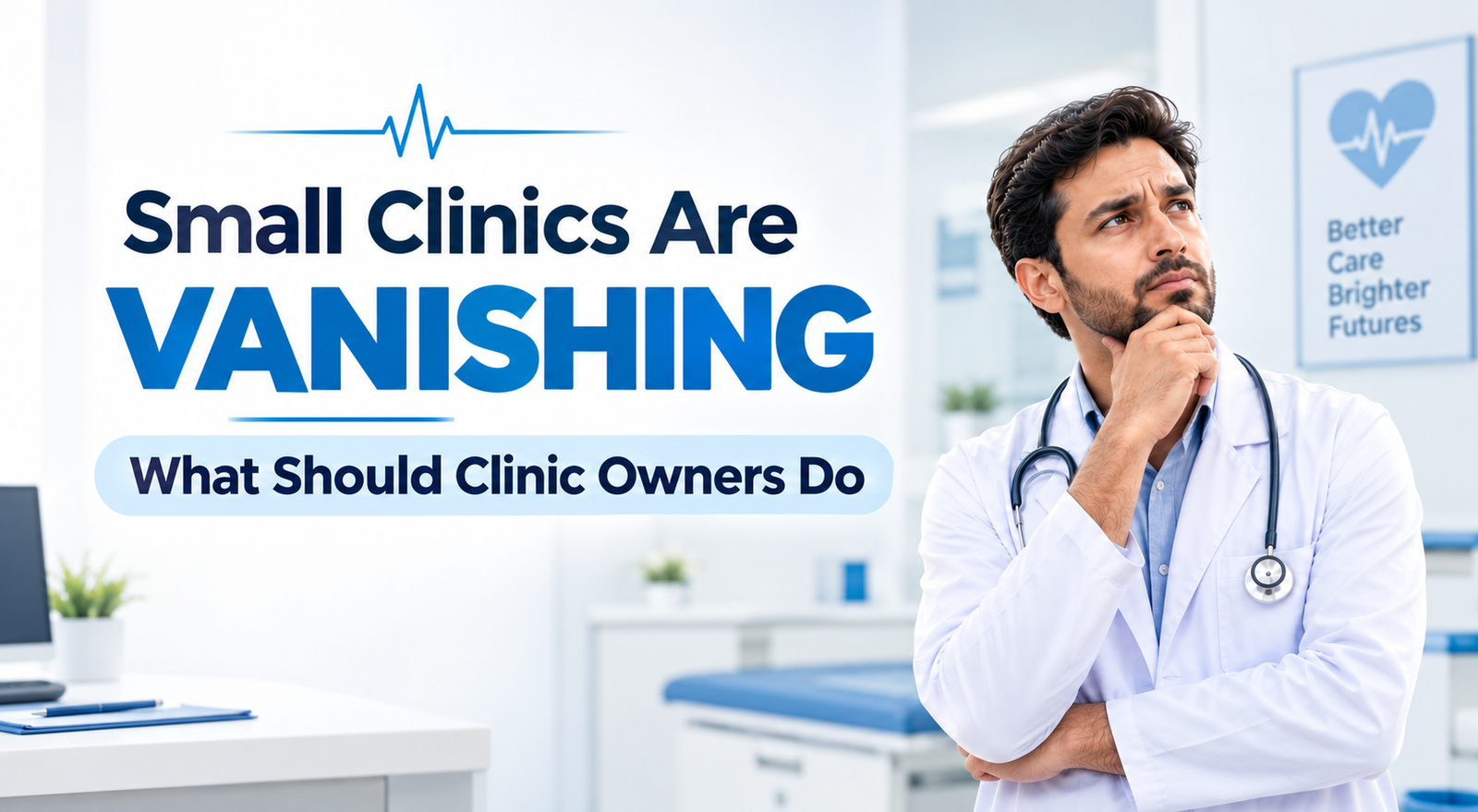
Small clinics are closing. But hospitals overall are growing. This isn’t shrinking. It’s a shift. And if you run a small clinic, this is the story you need to understand.
What’s Actually Driving This
The scale of this shift is bigger than most people think.
Big hospital chains across India are investing heavily in new hospitals and new beds, in a wave of growth the country hasn’t really seen before. These groups are also making serious money right now, and it shows. Investors have noticed too. One of India’s largest hospital chains went public this year and raised a huge amount of money in its listing, one of the biggest healthcare stock listings India has ever seen.
Once big money gets involved, a hospital starts running differently. Managers pay close attention to how full the beds stay, and how much money each bed brings in. That’s not always bad for patients, since it often means better equipment and facilities. But it does mean hospitals are being run like large, efficient businesses. And a small, personal clinic just isn’t built to compete on those terms.
Why Big Hospitals Are Winning So Easily
This isn’t really about better doctors. It comes down to a few simple advantages a small clinic just can’t match on its own.
Big hospitals can negotiate better deals with insurance companies, because they bring in so many patients at once. A clinic with one doctor and two staff members has no such power.
They can afford expensive machines and specialists that a small clinic never could. If someone needs a rare specialist or a certain kind of scan, a big hospital usually has it under one roof.
They also spend heavily on advertising. So when someone falls sick, a big, familiar hospital name is often the first thing that comes to mind, even if a smaller clinic nearby could treat the same problem just as well.
And honestly, most small clinics were never built to fight this kind of battle. They were built around one doctor’s reputation and word of mouth, at a time when that alone was enough to run a practice for decades.
What This Is Really Costing Small Clinics
This isn’t just about clinics shutting down. There’s a quieter cost too.
Many doctors running their own practice are working longer hours for less money, just trying to keep up with rising costs. A lot of them end up competing purely on price, which is a fight they can’t win against a hospital chain with much deeper pockets.
There’s also a generation problem. Many doctors who built their clinic over decades are finding that their own children don’t want to take it over. It’s often easier, and more stable, to join a big hospital as an employed doctor than to run an independent clinic through all this change alone.
So the pressure here isn’t only about money. It’s about whether running your own clinic even has a future anymore.
What Most People Miss About This Story
Despite everything working against them, small clinics haven’t disappeared. And in some places, they’re actually finding a real edge that big hospitals genuinely can’t copy.
Big hospitals are often slow. Long queues. Confusing billing. Several departments just to get one simple answer. People are tired of what’s now called the “hospital maze.” A small clinic that offers same-day appointments, a doctor who actually remembers your name, and a quick way to get help, offers something a big chain can’t buy, no matter how much money it spends.
There’s something else worth knowing. Independent doctors report far less burnout than doctors working inside big hospital systems. Mainly because they still control their own schedule and how they practice. That difference shows up in how patients are treated too. A doctor who isn’t burned out, and isn’t chasing a revenue target for every bed, tends to build deeper trust with the people they treat.
So the real question for a small clinic isn’t, “how do we out-hospital the hospital.” That’s a fight most clinics will lose. The real question is, “how do we become genuinely excellent at the things a big hospital will always struggle to offer.”
What Small Clinics Can Actually Do
If you run a small practice, or you’re thinking of starting one, here’s where I’d focus.
- Make it effortless to see you. Same-day appointments, quick replies, no long waits just to book a basic visit. This alone sets you apart from most big hospitals.
- Use simple tools to cut the paperwork. Basic digital tools can now handle scheduling, records, and reminders. This lets you run smoothly without needing a hospital-sized budget.
- Protect your relationships on purpose. Patients already trust you more than a random doctor at a big chain. Don’t assume that trust will just stay there on its own.
- Team up without giving up your independence. Small groups of independent doctors are now joining together to get better insurance deals, while still running their own clinics.
- Be easy to find online. A simple, honest presence online matters more today than it ever has. People searching for care nearby should actually be able to find you.
None of this needs a hospital-sized budget. It needs a clear decision to actually compete on what you’re good at, instead of quietly hoping things go back to how they used to be.
The Real Question for Small Clinics
Healthcare in India is changing fast, and there’s no real way to stop that. Big hospital chains will keep growing. That’s just the direction things are heading.
But that doesn’t mean small clinics are finished. It means the ones who survive will be the ones who stop trying to act like a smaller hospital, and instead get genuinely excellent at the personal, fast, trusted care that made people choose them in the first place.
If you’re a doctor or clinic owner trying to figure out how to actually compete in this changed world, I’m Rahuul Kumar Jain. As a business coach in India who works closely with healthcare and service businesses, I’d be glad to help you think this through properly.
Because the clinics that disappear usually aren’t the ones with worse doctors. They’re the ones that never adjusted to a market that had already changed around them.