Two Businesses, Same Market, Very Different Years
Picture two small businesses sitting in the same city, selling more or less the same thing.
One replies to customers within minutes. It writes its own marketing content in half the time it used to take. It knows which products are about to run out before they actually do, and barely spends any time on paperwork anymore.
The other one is still doing everything the old way. Same effort, same long hours — but somehow, always a step behind.
I’ve sat across the table from both kinds of business owners, and the difference between them almost never comes down to hard work. Usually, it’s whether AI is quietly running in the background of one business and completely absent from the other.
I get why “AI” sounds like a big, intimidating word to a lot of business owners — like something built for large tech companies with huge budgets and technical teams. Honestly, it isn’t, not anymore. Let me walk you through what this actually looks like for a small business in India.
This Is Already Happening, Not Something Coming Later
Let’s start with what’s true right now, not what might happen someday down the line.
A Salesforce study on small and medium businesses found that 78% of Indian SMBs are already using AI, or at least actively experimenting with it. Of the businesses already using it, 93% say it’s actually helped increase their income (Salesforce SMB Trends Report, via indiaai.gov.in, 2026).
Now here’s the more honest, less flattering part of the picture. NASSCOM’s own research found that only 14% of Indian small businesses are using AI in any real, planned way — compared to 38% in the US and 41% in the UK (NASSCOM, January 2026).
Both of these numbers are true at once, oddly enough. A lot of Indian businesses have started poking around with AI. Very few have actually built it properly into how they operate day to day. That gap is exactly where the real opportunity sits, for anyone willing to move a little earlier than everyone else.
It’s Not Just Chatbots — Here’s the Bigger Picture
When people hear “AI for business,” they almost always picture a chatbot answering customer messages. That’s one real, useful case. But it’s a small piece of a much bigger picture, and I think most business owners are missing that.
Per the same Salesforce data, the three most common uses of AI among Indian small businesses today are customer service chatbots, marketing campaign planning, and creating content — posts, product descriptions, ad copy (Salesforce SMB Trends Report, via indiaai.gov.in, 2026).
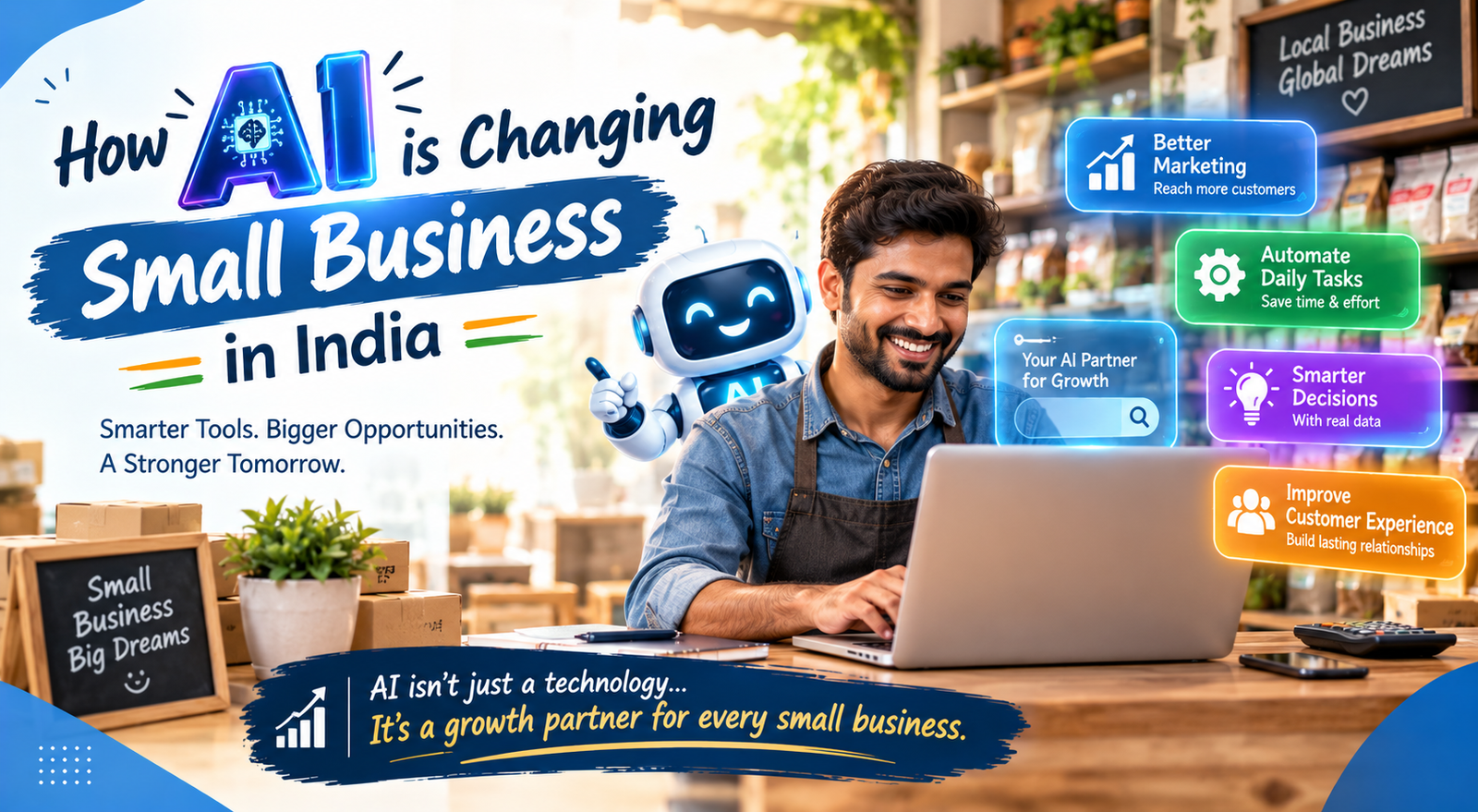
But it stretches quite a bit further than that. Here’s a fuller picture of where it’s actually showing up:
- Customer support. Answering common questions instantly, on WhatsApp or wherever your customers already talk to you, at any hour, without a person sitting by the phone.
- Marketing and content. Writing product descriptions, ad copy, and social posts in minutes rather than the hour or two it used to eat up.
- Inventory. Predicting what’s going to sell, spotting stock issues before they become a real problem, cutting down delivery delays. Some businesses have seen supply chain costs drop by close to 30% using AI tools built for exactly this (Zinnov, 2026).
- Hiring. A growing number of Indian recruiters now lean on AI for resume screening — 60% do, and 45% even use it for early interview rounds (Taggd & CII, India Decoding Jobs Report, 2026).
- Everyday admin. Scheduling, reminders, basic bookkeeping — the repeated tasks that quietly eat hours out of every week without you noticing.
None of this needs a technical background, by the way. Most of these tools today are built for someone with a phone and no coding knowledge whatsoever.
What This Actually Saves You
Here’s the bit that tends to convince business owners more than anything else I can say.
Small businesses using AI properly save around 5.6 hours a week on average. Owners themselves sometimes save even more — over 7 hours a week — just by cutting repeated manual work out of their day (Business.com research, via Booth Associates, 2026).
Sit with that for a second. Seven hours a week is close to a full extra working day, every single week, that could go toward actually growing the business instead of retyping the same reply for the fifth time that day.
Where I See Founders Get This Wrong
I want to be upfront about a mistake I run into a lot.
A business owner hears about some AI tool, tries it for a week, doesn’t see an obvious result right away, and quietly gives up on the whole idea. I see this constantly. Nine times out of ten, the tool isn’t actually the problem. Nobody set it up with a clear goal in mind, and nobody gave it enough time to actually learn how the business works.
There’s also a smaller group who genuinely believe AI just doesn’t apply to a business their size. In my experience, that’s almost never true. It’s usually a gap in what they know, not an actual limitation of their business.
And to be fair, around 41% of Indian business leaders admit they’re worried about falling behind competitors here (Salesforce SMB Trends Report, via indiaai.gov.in, 2026). That worry isn’t unreasonable. But worry on its own has never fixed anything. A clear plan does.
Where I’d Actually Tell You to Start
If you’re wondering where to begin, here’s the order I’d genuinely suggest, based on what’s worked for the founders I’ve sat down with.
- Start with one real problem, not a big strategy. Maybe it’s slow replies. Maybe it’s the hours you lose writing content every week. Pick whatever’s costing you the most right now.
- Choose a tool that fits how your customers actually behave. For most Indian businesses, that still means something that works well on WhatsApp and can handle Hindi and English mixed together without falling apart.
- Give it a real month before deciding it doesn’t work. Most people quit in week one. The businesses that actually see results gave the tool time to learn their business properly.
- Keep an actual human being for anything emotional or sensitive. AI handles repeated, simple tasks brilliantly. Complaints, refunds, anything personal still needs a real person on the other end.
- Track one clear number. Hours saved, faster replies, leads followed up properly — pick just one, and check it again after thirty days.
Where I Come In
Most founders I work with don’t need to become AI experts, and honestly, most of them don’t want to. What they actually need is someone to look honestly at their specific business and tell them where AI would genuinely help — and just as importantly, where it wouldn’t do much at all.
As a Business Growth Strategist and Strategic Business Advisor, here’s roughly what that looks like with clients:
- Business Process Assessment — finding the exact places in a business where AI could genuinely save time or catch revenue that’s currently slipping through, based on how that business actually runs, not guesswork.
- Tool Selection and Setup — helping a founder pick the right, affordable tools for their specific situation, rather than whichever tool has the loudest marketing that month.
- Team Training and Adoption — because a tool nobody actually uses is worth nothing. This is about making sure the team sticks with it past week one.
- Growth Strategy Integration — connecting how a business uses AI to its bigger goals, so it becomes a real advantage instead of a gadget sitting there unused.
If you’ve heard all of this before and still haven’t done anything about it, you’re genuinely not alone. Most business owners are exactly where you are right now. The ones who move a little earlier are simply the ones who’ll have the advantage a year from now.
The Real Question
AI isn’t going to replace good business owners. But the ones using it well are already quietly pulling ahead of the ones who haven’t started yet.
This was never about becoming a tech expert overnight. It’s about not losing seven hours a week to work a tool could already be doing for you.
If you’re looking for the best business consultant in India to help you figure out what AI actually means for your specific business — without the jargon, without a sales pitch — I’d genuinely like to have that conversation with you.
Because the businesses that figure this out early won’t just save time. They’ll be the ones still standing out five years from now.