A Question I Ask Every Client
Let me ask you something. Please answer it honestly.
When was the last time you finished a workday and felt you truly moved your business forward?
Not just cleared your inbox. Not just sat in meetings. Not just replied to messages. I mean you actually built something. You actually made progress on something important.
For most business owners I meet, this feeling does not come often.
You end the day tired. You were busy every hour. But something still feels wrong. The important things did not get done today.
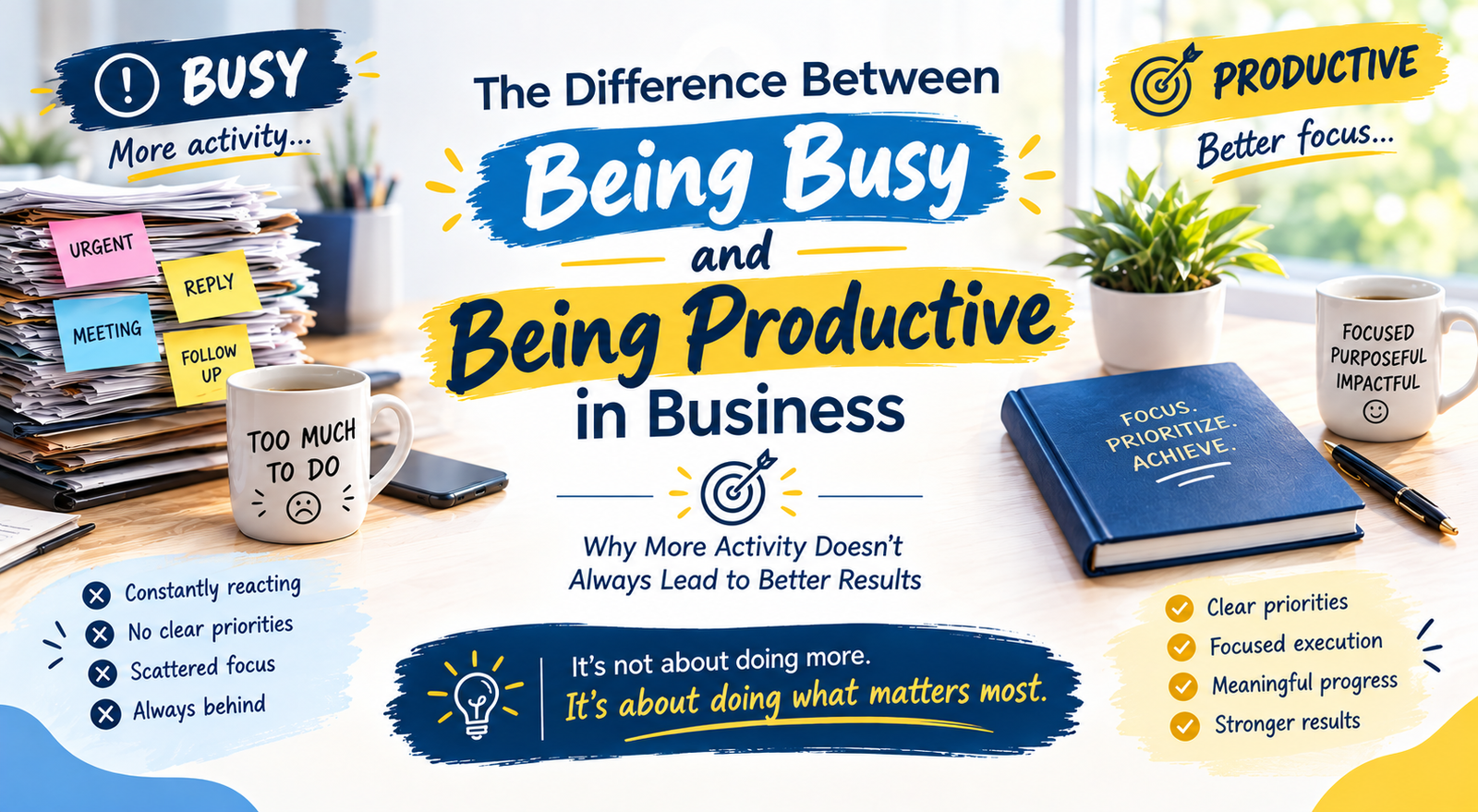
I see this again and again. Here is the truth: being busy and being productive are not the same thing. Busy fills your day. Productive builds your business. Mixing these two up is costing you more than you think.
What Is Really Happening
Being busy is often seen as good work. A full calendar looks like hard work. Many meetings look important. Staying late looks like commitment.
But ask yourself honestly. How much of your last five days really helped your business grow?
Being productive does not mean doing more work. It means using your time well. It means giving your best time and energy to the few things that matter most, instead of letting small, urgent tasks take over your day.
McKinsey has studied this. Their research shows that businesses which focus on doing the right work do better than businesses that just work more hours. (Source: mckinsey.com)
I have seen this with many of my clients. The most successful businesses are not the busiest ones. They are the ones with the clearest focus.
Signs You Are Stuck in the Busy Trap
Read this list slowly. Most business owners see themselves here, but still do not change anything.
- Your calendar is full, but your main goals do not move forward. Important work keeps getting pushed to next week, then next month.
- Most of your day goes into solving problems and answering messages. By the time this is done, there is no time left for important work.
- You are working longer hours, but the results are not better. This is usually not a market problem. It is a focus problem.
- You have no time to think or plan. You have no time to ask where your business is really going.
- Growth has become slow. Deep down, you already know why. The opportunity is there. But your time and energy are going in too many directions.
Why This Keeps Happening
Everything feels urgent, so nothing gets clear priority. When every task feels important, the truly important work gets lost. This is not because you do not care. It is because nothing is protecting that important work.
Your day gets decided before you even plan it. If you do not plan your day yourself, the first email you read will decide your day for you.
Meetings slowly take over your time. Many meetings are not as necessary as they feel. But they feel useful, so more and more get added. This uses up hours that could go toward more important work.
The owner stays involved in everything. This usually comes from good intentions. The owner knows every part of the business well. But when every decision needs the owner’s approval, the whole business becomes slow.
Also, many businesses never build proper systems. So every task and every decision needs manual work, every single time. This extra work builds up quietly. It becomes heavier as the business grows.
Microsoft has also studied this. Their research shows that most employees spend most of their time on meetings, emails, and small admin tasks. Very little time is left for real, important work. (Source: microsoft.com/worklab)
What This Is Costing You
The growth that should happen does not happen. Important, strategic work needs your full attention. When your attention goes to daily small tasks instead, growth does not stop suddenly. It stops slowly, without you noticing.
Your best employees start to lose interest. Being busy without real progress makes people tired in their mind. The energy in the team changes. By the time you notice this clearly, it has already been happening for some time.
Your decisions become weaker, without you realising it. A tired and overloaded mind makes faster decisions, not better ones. Your judgment becomes weaker under constant pressure. The business suffers because of this, even if it is hard to see why.
There is no space left for new ideas. New ideas and better ways of working need free time to think. Constant busyness removes that free time completely. The business stops improving, not because people stop caring, but because there is no time left to think clearly.
What Actually Makes a Difference
I tell my clients the same simple things, because these things really work.
- Decide clearly what matters most. A few important activities create most of your results. Give these your best time and attention. Question everything else.
- Plan your day before it starts. Before you check your email, decide what this day needs to achieve. Choose two or three important things for the week. Protect time for these.
- Delegate work fully, not partly. Your business grows when you focus only on what only you can do, and give the rest to your team completely. Trusting your team with real work is one of the most powerful things a business owner can do.
- Build simple systems. Write down your steps. Create clear processes. Use the right tools. This is not extra rules — it is a better way to work. It lets the business run well without depending only on you or a few key people.
- Measure results, not hours worked. Working many hours does not mean success. What matters is what changed, what grew, and what was actually achieved.
Harvard Business Review has found the same pattern many times. Businesses that protect time for real, focused work do better than businesses that confuse busyness with real progress. (Source: hbr.org)
How I Help Business Owners With This
Here’s what I’ve noticed after years of doing this. Most business owners don’t actually have a hard-work problem. They have a direction problem. Ask anyone who knows them — they’ll tell you this person works hard, cares deeply, shows up every single day. What’s usually missing isn’t effort. It’s clarity on where that effort should actually go.
So when a client sits down with me, we don’t talk about working harder. We talk about the right things to work on. We talk about systems that can carry some of the load. And we talk about what leadership should actually look like for that specific business, at that specific stage.
As a Business Growth Strategist and Strategic Business Advisor, this is usually where I end up spending my time with clients:
- Business Productivity Assessment. First, we find out exactly where time and energy are leaking. Not guesswork — an actual look at where the day goes.
- Strategic Business Planning. Then we build a plan that’s honest about where the business is, and connects daily work to the goals that actually matter.
- Process Improvement and Workflow Optimisation. A lot of repeated manual work can just… stop being manual. We build simple systems for that.
- Leadership and Time Management. This is often the biggest one. Getting an owner’s time back changes almost everything else.
- Team Performance Enhancement. And finally, building a team that takes real ownership, so growth doesn’t rest entirely on one person’s shoulders.
One Last Thing
I’ll be honest with you — the best business owners I’ve worked with weren’t putting in more hours than everyone else. If anything, some of them worked less than the owners still stuck in the busy trap.
What set them apart was simpler than that. They got honest about where their time was actually going. And then they did something about it, even when it was uncomfortable.
Busy feels safe. It feels like proof you’re trying. But your business isn’t keeping score on effort. It’s keeping score on results.
So here’s the question worth sitting with tonight: are you actually moving your business forward, or are you just moving?
Let’s Fix This Together
If you’re tired of putting in the hours without seeing the growth to match, I’d like to talk.
I’m often called the best business consultant in India by the founders I’ve worked with — not because of a title, but because we actually fixed the problem together. Book a call, and let’s figure out what’s really holding your business back.