Let me ask you something honestly.
Have you ever sat in a business meeting and realized halfway through that you weren’t really talking about strategy anymore — you were replaying a conversation from twenty years ago at the dinner table?
If you’ve ever run a business with family, you probably know exactly what I mean.
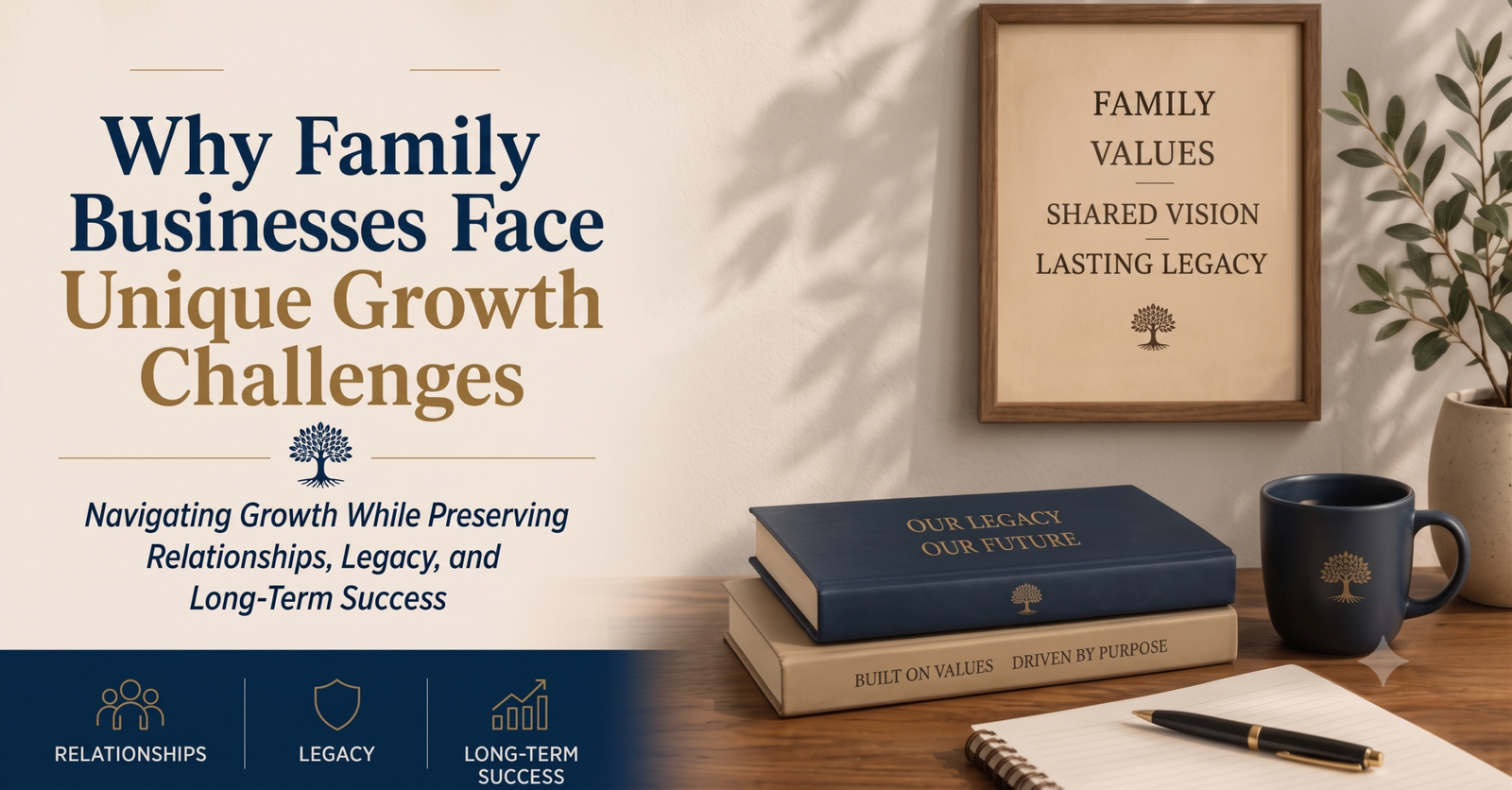
Family businesses are extraordinary things. They’re built on trust that took decades to earn, values that were passed down rather than written in a policy document, and a level of commitment that no employment contract can manufacture. In India, they aren’t just common — they are the foundation of how business works. From the small trader who’s been at the same corner for thirty years to the multi-city enterprise now in its third generation, family businesses shape our economy in ways that often go unrecognized.
But here’s what doesn’t get talked about enough: the very things that make family businesses so strong are often the same things that make them so hard to grow.
The closeness becomes conflict. The loyalty becomes limitation. The legacy becomes a weight rather than a launching pad.
And navigating all of that — while also trying to actually run and grow a business — is genuinely hard.
What We’re Really Talking About
At its core, a family business is one where ownership, management, or real decision-making power stays within a family. That setup creates something genuinely rare in the business world — long-term thinking, deep trust, and a personal investment in outcomes that goes beyond quarterly targets.
But growth has its own demands. It doesn’t care how hard you’ve worked or how much you love what you’ve built. It asks for systems, strategy, honest leadership, and decisions made for the right reasons — not the comfortable ones.
PwC’s Global Family Business Survey found that most family businesses feel genuinely positive about their future. But dig a little deeper, and many of them quietly admit that succession planning, governance, and talent are keeping them up at night.
Source: https://www.pwc.com/gx/en/services/family-business/family-business-survey.html
The tension that sits at the center of almost every family business challenge is this: how do you make clear-headed business decisions when the people in the room are also the people you love, argue with, protect, and sometimes quietly resent?
That tension doesn’t go away by ignoring it. It just gets more expensive.
Signs Your Business Might Be Hitting a Wall
Most family businesses don’t suddenly fall apart. They slow down gradually — so gradually that it’s easy to mistake it for just a difficult phase or a tough market.
Here are the real signs worth paying honest attention to:
Decisions take forever — and everyone knows why. The business needs to move, but nothing gets signed off because two family members aren’t aligned, and nobody wants to be the one who forces the issue. So the decision waits. And waits.
Nobody’s quite sure who does what. One person ends up doing three jobs. Another floats between departments without a clear mandate. Things get done, sort of — but accountability is murky and inefficiency quietly compounds.
Work conversations stop being about work. A disagreement about a vendor becomes a conversation about who gets listened to in this family. A budget discussion surfaces a grudge from five years ago. The professional and personal have bled into each other so completely that it’s hard to separate them anymore.
Good people come — and then they leave. Talented professionals join the business with real enthusiasm. Then they slowly realise that the important decisions will always be made by family, regardless of performance or expertise. So they stop trying as hard. And eventually, they go somewhere their contribution actually counts.
The next generation isn’t ready — and nobody’s saying it out loud. The founder’s child has a title, maybe even a corner office. But the honest conversations about whether they’re truly prepared to lead haven’t happened yet. And the longer that goes unaddressed, the more fragile the business becomes.
Growth has quietly stalled. The market opportunity is real. The business has a good name and loyal customers. But somehow, it just can’t seem to break through to the next level. The internal friction is costing more than anyone wants to admit.
If you recognised your business in more than one of these, you’re not alone — and more importantly, none of it is permanent.
Nobody Wants to Have the Succession Conversation
It’s uncomfortable. It brings up questions about mortality, about fairness, about whether the next generation is actually ready. So it gets postponed. And postponed again. Until suddenly it’s urgent — and being handled under pressure instead of with care.
The Family Business Institute found that only about 30% of family businesses make it successfully to the second generation. Even fewer reach the third.
Source: https://familybusinessinstitute.com
That statistic isn’t about bad luck. It’s largely about conversations that were never had and plans that were never made.
Why This Really Happens

The Heart Overrules the Head
When the person across the table is your father, your sibling, or your spouse, objectivity becomes genuinely difficult. Decisions get made to preserve the relationship, honor a tradition, or avoid an uncomfortable weekend at home — rather than because they’re actually right for the business. That’s not weakness. It’s human. But it has a cost.
Nobody Wrote Down the Rules
Many family businesses run on unspoken understanding — everyone just knows their role, how decisions get made, and where the lines are. That works when the business is small and the family is aligned. But as things grow, those unspoken rules start colliding. And without a formal structure to fall back on, things get messy fast.
Change Feels Like Criticism
When a business has been built a certain way over decades, suggesting a different approach can feel like saying the people who built it were wrong. That emotional weight around change — even clearly beneficial change — creates a slow, quiet resistance that holds businesses back year after year.
The Kitchen Table Follows You Into the Boardroom
When Sunday dinner and Monday’s board meeting involve the same people, the emotional history in that room is enormous. Old dynamics, old wounds, old patterns — they all show up at work, whether anyone acknowledges them or not. And when they go unmanaged, they quietly shape decisions that should be made purely on business logic.
The Challenges That Actually Limit Growth
No clear plan for who leads next creates a low-level anxiety that spreads through the whole organisation. Employees wonder. Customers wonder. Key partners wonder. And that uncertainty costs trust.
Family conflict in the business doesn’t stay contained. It slows decisions, creates factions, and sends a signal to everyone watching that the organisation’s priorities are internal rather than market-facing.
Informal systems that never got upgraded are a growth ceiling disguised as tradition. What worked at ten employees quietly breaks at fifty. What worked at fifty silently fails at two hundred.
Non-family talent hitting invisible walls leads to a specific kind of brain drain — you lose the most capable people, because capable people have options. And they will use them when they stop feeling valued.
Scaling requires things most family businesses haven’t built yet — documented processes, clear accountability, specialised expertise, and systems that work even when the founder isn’t in the room.
Investment decisions shaped by family dynamics rather than business logic can quietly drain capital and energy away from where they’d actually create the most growth.
None of these challenges are fatal. But left unaddressed, they compound — and the gap between what the business could be and what it actually is keeps widening.
What Actually Makes a Difference
Create a governance structure that everyone genuinely respects. Not just on paper — one that people actually use when decisions get hard. Clear rules about who decides what, how conflicts get resolved, and what accountability looks like. This single change removes an enormous amount of daily friction.
Make the separation between family and business real, not theoretical. Have business conversations in business settings, with business-appropriate behaviour. Have family conversations elsewhere. It sounds obvious. Most family businesses still haven’t done it properly.
Start the succession conversation before you think you need to. Identify future leaders, give them real responsibility and real feedback, and build their capability over years — not months. The businesses that do this well don’t just survive transitions. They grow through them.
Base roles on capability, not family position. When everyone’s responsibilities are defined by what they’re actually good at — rather than where they sit in the family tree — accountability becomes natural rather than forced.
Build the systems that will carry the business forward. The processes that got you here won’t get you where you want to go. Investing in proper structure isn’t about losing the family feel — it’s about making sure the business is strong enough to keep that feel for another generation.
Develop leaders continuously and seriously. Future leaders need real skills — strategy, finance, people management, market thinking. The market has no nostalgia for legacy. It rewards competence.
Bring in an outside perspective when the inside view has run out of runway. Sometimes the most valuable thing is someone who can see clearly because they aren’t carrying the history.
PwC consistently finds that family businesses which embrace professional governance and strategic planning outperform those that don’t — over the long term, and especially through transitions.
Source: https://www.pwc.com
How Rahul Kumar Jain Can Help Your Family Business
Growing a family business isn’t just a strategic challenge — it’s a deeply personal one. And that’s exactly why generic consulting advice rarely works. You don’t just need someone who understands balance sheets and org charts. You need someone who understands what it actually feels like to sit in a room where business decisions carry the weight of family relationships, generational expectations, and years of shared history.
That’s where Rahul Kumar Jain comes in. With deep experience working alongside family-owned businesses across India, Rahul doesn’t just diagnose problems from the outside — he works closely with business owners and their families to understand what’s really going on beneath the surface, what’s working, what isn’t, and what needs to change for the business to genuinely move forward. His approach is honest, practical, and built around your specific situation — not a template pulled off a shelf.
Whether you’re navigating a leadership transition, trying to professionalize the business without losing its soul, or simply feeling like the business has stopped growing and you’re not sure why — Rahul brings the clarity, structure, and support needed to take the next step with confidence.
His consulting services help family businesses:
- Build scalable growth plans — because ambition without a roadmap is just hope.
- Improve organizational structure — so everyone knows their role and owns it fully.
- Develop succession strategies — so the next generation steps up ready, not scrambling.
- Strengthen leadership capabilities — because strong businesses are built on strong leaders.
- Establish accountability systems — so performance drives decisions, not politics.
- Resolve operational bottlenecks — so the business stops bleeding time, money, and energy.
- Create long-term business roadmaps — so the family’s vision and the business’s future finally point in the same direction.
A Final Thought
Family businesses carry something genuinely rare — a depth of trust, a long-term commitment, and a sense of purpose that most organisations spend years trying to manufacture and never quite achieve.
Those are real, meaningful advantages.
But they only compound over time when they’re paired with honest conversations, proper systems, and the courage to build something that can outlast any single person in it.
The businesses that get this right — that find a way to honor what the family built while having the hard conversations that growth demands — aren’t just the ones that survive. They’re the ones that, a generation later, everyone points to and says: how did they do it?
The answer is almost never luck.
It’s usually that someone, at some point, decided to stop avoiding the difficult things — and started building something that could actually last.
Ready to Take the Next Step?
Is your family business facing challenges around growth, leadership transitions, succession planning, or operational efficiency?
Rahul Kumar Jain helps family-owned businesses build stronger foundations for long-term success — through strategic consulting, leadership development, and practical growth planning.
Schedule a consultation today and find out how your family business can break through growth barriers, strengthen its leadership, and build a legacy that truly lasts.